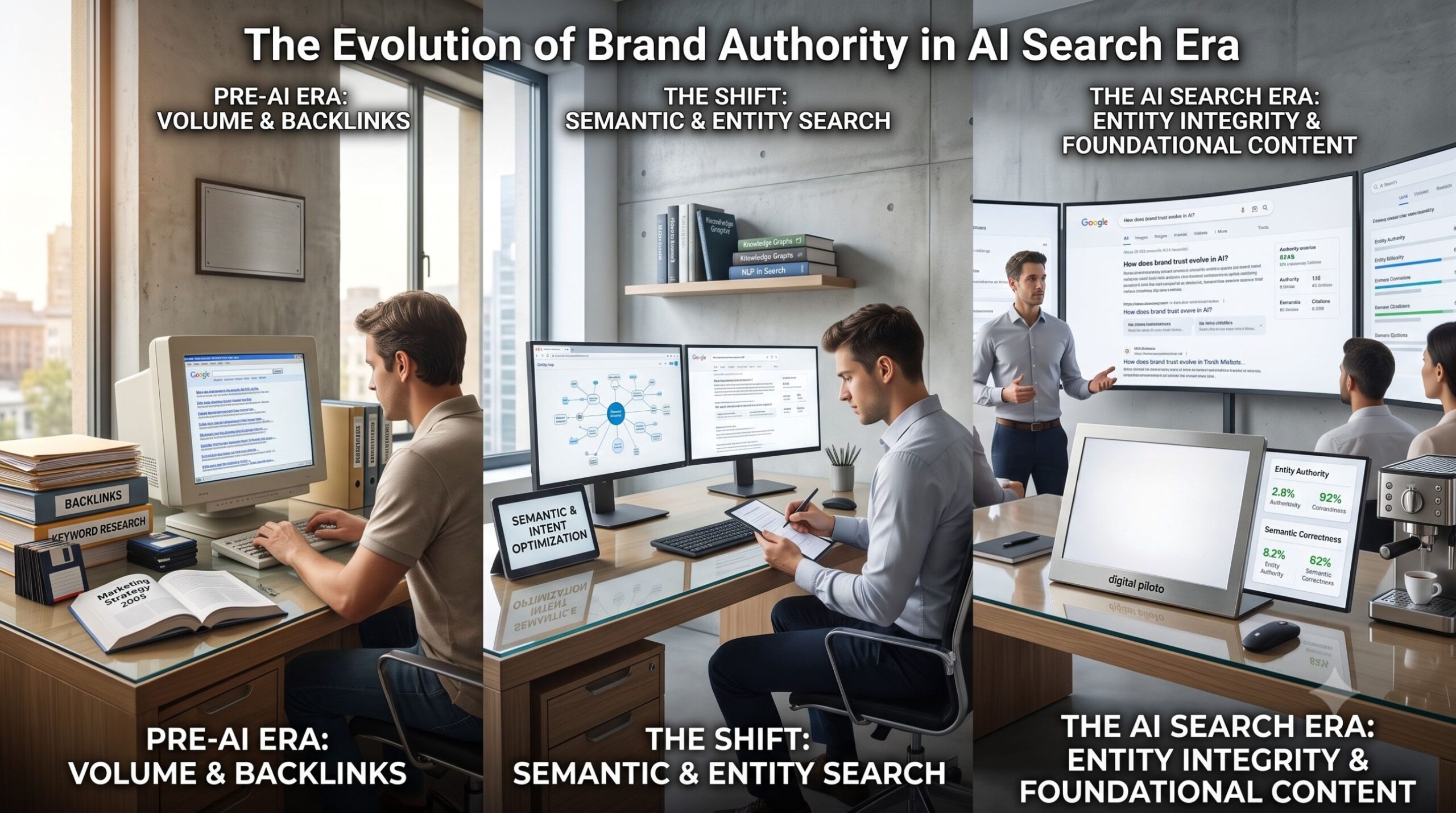
Brand authority once meant earning strong rankings, collecting backlinks, and becoming familiar to customers. AI search is quietly changing that definition. Today, a brand can be discovered, summarized, compared, or recommended without a customer ever visiting its website first. The challenge is no longer simply being visible—it is becoming a source that intelligent systems can confidently understand and trust.
For businesses working with a digital marketing company in Kolkata, this shift deserves serious attention. Traditional SEO still matters, but brand authority now stretches across websites, reviews, expert commentary, third-party mentions, structured information, original research, and the wider digital ecosystem surrounding a company.
Brand Authority Used to Be Easier to Recognize
There was a time when brand authority had fairly visible markers. A company ranked on the first page. Industry websites linked to it. Customers mentioned it on social media. Journalists quoted its executives. Search engines gradually connected those signals and rewarded the brand with stronger visibility.
That model has not disappeared. It has become more complicated.
AI-powered search can now synthesize information from multiple sources and produce an answer before a user decides which website to visit. Google says AI Overviews and AI Mode are designed to help users explore information while connecting them with relevant websites, sources, and original content. By 2026, Google reported more than 2.5 billion monthly active users for AI Overviews and more than one billion monthly users for AI Mode.
That scale changes the strategic question. A brand does not only want to rank. It wants its information to remain recognizable and credible when an AI system assembles an answer from many pieces of the web.
From Ranking Authority to Recognition Authority
Imagine a customer asks an AI search engine, “What are the best digital marketing agencies for an Indian B2B company that wants stronger visibility in AI search?”
The answer may not resemble a traditional search results page. Instead, the system may compare businesses, interpret their services, examine reviews or third-party references, and summarize what appears to be relevant.
That means brand authority increasingly has two dimensions:
- Search authority: the ability to perform well in conventional organic search.
- Recognition authority: the ability to be consistently understood and represented across AI-driven discovery environments.
- Trust authority: the collection of independent signals that make a brand appear credible rather than self-proclaimed.
The interesting part is that these dimensions overlap. A technically weak website can undermine AI discoverability. A brand with vague positioning can be difficult for both people and machines to categorize. A company with impressive claims but little independent evidence may struggle to build durable trust.
AI Search Is Making Brand Context More Important
Traditional keyword optimization often asks, “Which phrase should this page target?” AI search encourages a broader question: “What does this brand represent, and can the web clearly prove it?”
This is a meaningful change.
Suppose a cybersecurity company repeatedly describes itself as an enterprise security specialist. That statement becomes more useful when the company’s website, founder profiles, conference appearances, technical publications, client discussions, industry directories, and independent articles consistently reinforce the same area of expertise.
The brand starts becoming an identifiable entity rather than just a collection of optimized webpages.
Google’s recent AI Search developments emphasize original content, firsthand perspectives, relevant websites, and links that allow users to explore sources behind AI-generated responses.
The Rise of the Brand Evidence Layer
One of the biggest mistakes companies can make in the AI search era is assuming that authority comes from publishing more content.
More content can help, but quantity alone is a weak strategy. What matters increasingly is evidence.
Think of brand authority as a house. Your website is the building, but the evidence around it forms the foundation. If the website says one thing and the rest of the internet says nothing—or worse, says something contradictory—the structure becomes less convincing.
A stronger evidence layer can include:
- First-party expertise: original insights, research, case observations, expert commentary, and detailed service information.
- Third-party validation: reputable publications, industry associations, reviews, interviews, and independent references.
- Entity consistency: accurate names, people, company information, locations, products, and relationships across important platforms.
- Customer evidence: authentic reviews, testimonials, case studies, and real-world outcomes.
- Freshness: information that continues to reflect what the company actually does today.
This does not mean businesses should manufacture mentions or scatter their name across irrelevant websites. Artificial signals can create noise rather than authority. The goal is consistency backed by genuine activity.
Why Original Expertise Matters More Than Ever
AI can summarize existing information remarkably quickly. That creates a strange paradox: the easier it becomes to produce generic content, the more valuable genuinely original information becomes.
Consider two articles about industrial machinery. One repeats publicly available specifications in slightly different language. The other includes observations from engineers, maintenance patterns seen across facilities, practical purchasing mistakes, and original analysis of operating costs.
The second article gives both readers and search systems something harder to replace.
Google has increasingly emphasized original and high-quality content in its search systems, while its newer AI Search experiences are designed to help users discover original perspectives and useful sources.
For brands, this creates a useful editorial rule: do not ask only, “Can we publish this?” Ask, “What can we add that another hundred websites do not already have?”
Brand Authority Is Becoming a Multi-Channel Job
Another important change is that authority no longer belongs entirely to the SEO team.
A company’s reputation is shaped by marketing, sales, customer service, product teams, executives, public relations, social channels, review platforms, and even the quality of information published by partners.
That is why AI-search visibility increasingly requires coordination.
A business might have excellent SEO but poor customer reviews. Another may have a strong reputation but an outdated website. A third might publish outstanding research but fail to clearly explain its services.
AI systems—and customers—encounter all of those signals.
What This Means for SEO Strategy
The role of an SEO agency Kolkata is therefore evolving. Technical SEO remains essential, but the strategic scope is expanding toward entity understanding, topical authority, content quality, digital reputation, and AI-search readiness.
A modern SEO strategy should consider:
- Whether the website clearly explains the business and its areas of expertise.
- Whether important information is accessible to search crawlers.
- Whether content demonstrates genuine expertise instead of generic summaries.
- Whether important claims have supporting evidence.
- Whether brand information is consistent across major digital properties.
- Whether customers can easily verify the company’s credibility.
Interestingly, Google’s current guidance does not recommend a special “AI SEO” shortcut. Its documentation continues to emphasize established search fundamentals such as crawlability, useful content, internal linking, textual information, and strong page experience.
That is good news for serious marketers. It means the fundamentals still matter. The difference is that the fundamentals now need to work within a broader discovery ecosystem.
Paid Media Still Has a Role in Brand Authority
Brand building is not purely organic. Paid visibility can help introduce a company to audiences while its longer-term authority is developing.
A PPC company in Kolkata can help businesses capture high-intent demand, test messaging, identify responsive audience segments, and bring new visitors into the brand ecosystem.
But there is an important distinction: advertising can buy attention, not genuine reputation.
If a paid campaign sends thousands of visitors to a website filled with vague claims and thin information, the problem has merely been amplified. Paid acquisition works best when it connects to a credible brand experience.
AI Search Is Changing How Customers Encounter Brands
The shift is not theoretical. Pew Research Center reported in June 2026 that 60% of U.S. adults said they had read AI summaries at the top of search results. Younger adults reported even higher exposure, with 72% of those aged 18–29 saying they had done so.
That means a customer’s first impression may increasingly come from a summary rather than a homepage.
And that summary may combine information from several places.
This creates an uncomfortable but useful question for business owners: if an AI system described your company today, would the description accurately reflect what you want customers to know?
If the answer is uncertain, there is work to do.
How Businesses Can Build AI-Ready Brand Authority
The answer is not to chase every new AI platform or invent a new acronym for every search update. A more durable approach is to strengthen the signals that make a business genuinely understandable and trustworthy.
- Clarify the brand: clearly define what the company does, who it serves, where it operates, and what makes its expertise distinctive.
- Publish evidence: replace generic claims with research, examples, original observations, case studies, expert commentary, and useful data.
- Strengthen the entity: keep company, founder, product, location, and service information consistent across relevant digital profiles.
- Earn independent recognition: pursue legitimate mentions, partnerships, interviews, reviews, industry contributions, and media coverage.
- Improve technical accessibility: make important information easy for search engines to crawl, understand, and connect.
- Monitor AI visibility: periodically test how customers might discover the brand through different conversational and generative search journeys.
The New Meaning of “Authority”
In the old search model, authority could sometimes feel like a scoreboard. Rankings were visible. Backlinks could be counted. Traffic could be plotted on a dashboard.
AI search makes authority feel more like reputation.
A system needs enough context to understand what a business is. It needs enough evidence to distinguish the business from competitors. And it needs enough trustworthy information to feel comfortable using that brand in an answer.
Google’s AI Search systems increasingly use techniques such as query fan-out to explore multiple related searches and sources before producing responses. That means a brand can potentially be encountered through several contextual paths rather than one exact keyword.
For marketers, this suggests a broader goal: build a brand that makes sense wherever the customer encounters it.
FAQs
What is brand authority in AI search?
Brand authority in AI search is the combination of expertise, reputation, consistency, relevance, and independent evidence that helps search systems and customers understand and trust a brand.
Is traditional SEO still important for AI search?
Yes. AI search does not eliminate technical SEO, useful content, crawlability, internal linking, or strong website experience. These remain important foundations for being discovered and understood.
How can a business improve its visibility in AI search?
Businesses can strengthen visibility by creating original expert content, maintaining consistent entity information, earning credible third-party mentions, improving technical accessibility, and answering customer questions clearly.
Can backlinks alone build brand authority?
No. Backlinks can contribute to authority, but durable brand recognition requires a wider combination of useful content, reputation, customer evidence, technical quality, consistent information, and genuine expertise.
Final Thoughts
Brand authority is moving from a ranking metric toward something much broader: being recognized, understood, and trusted across an increasingly fragmented search environment. Businesses that invest in genuine expertise, consistent digital signals, original information, and customer trust will be better prepared for that transition. In the AI search era, the strongest brand may not simply be the one that ranks first—it may be the one the system understands best.
This article was conceptualized by Amlan Maiti, developed through AI-assisted research, and refined with strategic SEO and content optimization by Digital Piloto Private Limited.