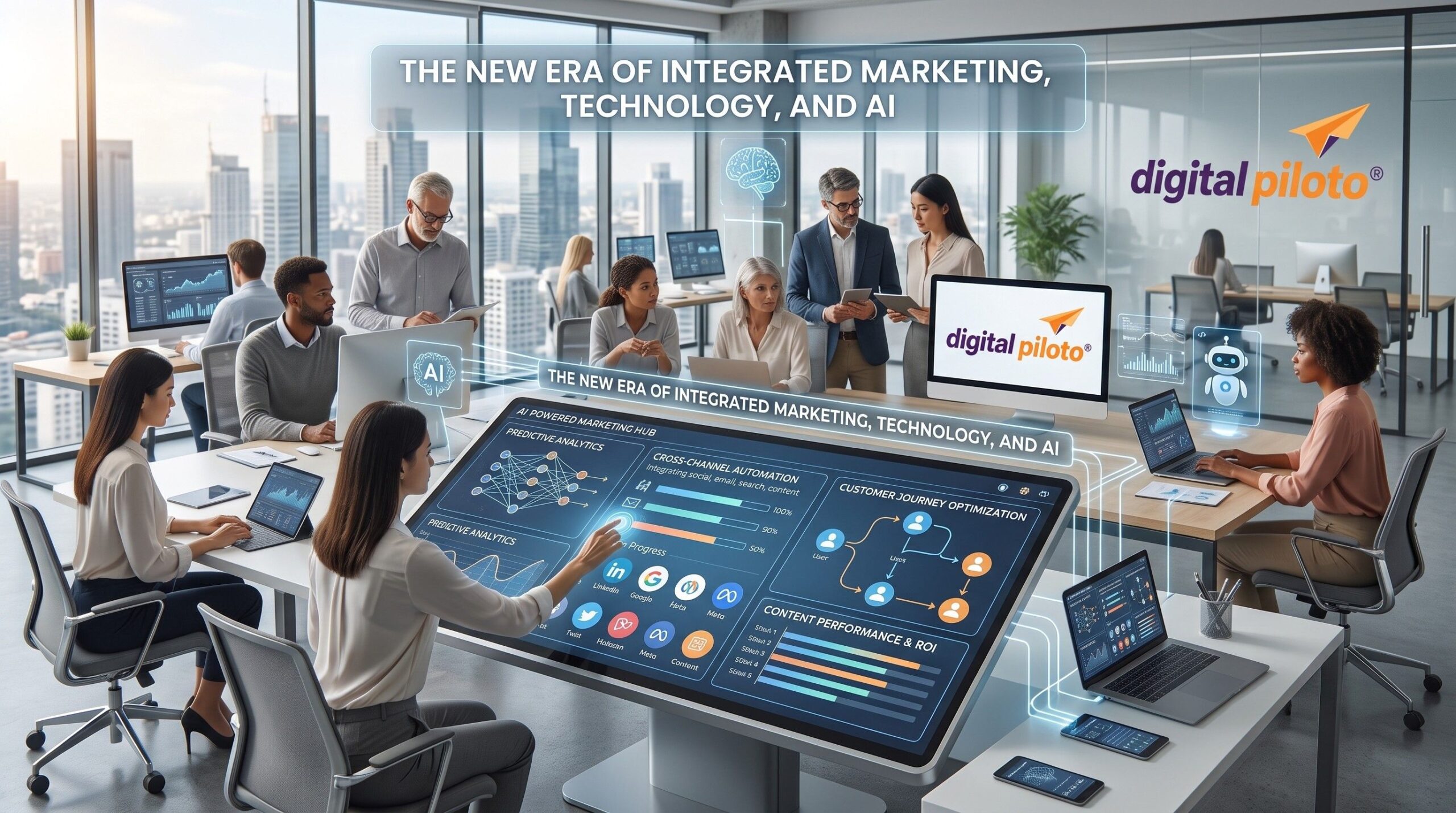
Marketing used to be organized around campaigns, channels, and calendars. That model is being stretched by connected data, automation, generative AI, and customers who expect instant, relevant interactions. The real change is deeper than adding another AI tool. Marketing, technology, and data are increasingly becoming one operating system for understanding customers, creating experiences, and driving measurable growth.
Marketing Is No Longer an Isolated Department
For years, marketing could operate as a relatively self-contained function. The marketing team created campaigns, the sales team followed leads, technology maintained the website, and customer service handled post-purchase conversations.
That separation is becoming harder to maintain.
A customer does not experience a company in departments. They experience one brand.
They may see an advertisement, search for the company, read a review, visit the website, interact with a chatbot, speak with sales, receive an email, and contact support. If each interaction contains different information or tone, the customer notices the cracks.
This is why modern digital marketing services in India increasingly need to work alongside analytics, CRM, automation, web technology, content systems, and AI rather than functioning as a standalone promotional activity.
The objective is not to make every department use the same software. It is to make the customer journey feel connected even when several systems are working underneath it.
The Shift From Campaigns to Continuous Marketing
The traditional campaign model still has value. Product launches, festive promotions, seasonal sales, events, and major brand campaigns all need planning.
But campaigns are no longer the whole story.
Customers keep searching, comparing, asking questions, changing preferences, and interacting with brands between campaigns. A company that only optimizes during scheduled campaign periods can miss valuable signals happening every day.
McKinsey’s 2026 research argues that AI is pushing marketing away from a campaign-centric model toward continuous growth, where insight, content creation, personalization, orchestration, and measurement work together more dynamically. Its research found that although many marketing leaders are experimenting with AI, fewer than 10% reported having scaled it or captured value across marketing workflows. McKinsey’s analysis of AI and the future of marketing highlights why simply adding AI tools is not the same as redesigning marketing.
That distinction is crucial.
AI can make a campaign faster. An integrated operating model can make the entire marketing function smarter.
Technology Has Become the Infrastructure Behind Marketing
Think of modern marketing as a building.
The advertising, content, email, social media, and SEO activities are what visitors see. Underneath them sits the infrastructure: customer data, analytics, CRM, automation, APIs, websites, content systems, and increasingly AI.
If the foundation is fragmented, adding more creative campaigns will not necessarily solve the problem.
A marketer may know that a customer downloaded a guide, but the sales team may not know. The CRM may contain purchase history, while the email platform does not. Website behavior may sit in analytics, completely disconnected from customer-service interactions.
AI cannot magically turn disconnected information into reliable intelligence.
In fact, the quality and accessibility of data may become one of the biggest determinants of AI-powered marketing performance.
Salesforce’s 2026 State of Marketing research found that 75% of surveyed marketers globally had adopted AI, yet 83% said customers increasingly expect two-way conversations with brands. The same research reported that 69% of marketers struggled to respond promptly because they lacked the necessary customer context. Salesforce’s State of Marketing 2026 report illustrates the tension between technological capability and disconnected data.
AI Is Becoming a Marketing Layer, Not Just a Tool
This is perhaps the biggest conceptual shift.
Earlier marketing technology often performed a specific task. An email platform sent emails. An analytics platform measured traffic. A CRM stored customer information. An advertising platform managed campaigns.
Generative AI can sit across several of these activities.
It can summarize customer feedback, identify patterns in campaign performance, generate creative concepts, adapt messaging for different audiences, analyze competitors, assist with research, and help teams turn raw information into usable briefs.
McKinsey’s 2025 research found that 71% of surveyed organizations were regularly using generative AI in at least one business function, with marketing and sales among the functions where adoption was particularly widespread. McKinsey’s generative AI adoption analysis provides the broader industry picture.
But there is a subtle danger here.
When AI becomes easy to access, businesses can end up generating more work rather than creating more value.
More social posts. More emails. More landing pages. More reports. More dashboards.
That is not integration. That is acceleration without direction.
Customer Data Is Becoming the Connecting Thread
Integrated marketing starts with a simple question: what do we actually know about the customer?
Not just their email address. Not just the page they visited. The broader context.
What problem are they researching? What content have they consumed? What objections have they raised? Have they purchased before? Are they comparing alternatives? What support issue did they recently report?
When those signals can be connected responsibly, marketing becomes much more relevant.
Salesforce’s India findings from its 2026 State of Marketing research reported that 81% of surveyed Indian marketers had adopted AI. However, the same research identified fragmented data as a major barrier to personalization; only 60% said they had complete access to service data, 61% to sales data, and 58% to commerce data. Salesforce’s India research shows why AI adoption and data integration need to progress together.
This is a useful lesson for businesses of every size: buying an AI platform is easier than creating a reliable customer-information ecosystem.
Personalization Is Moving From Segments to Context
Traditional personalization often meant dividing customers into groups.
New customer? Send this message.
Returning customer? Send that one.
High-value customer? Offer something different.
Segmentation still works. But AI can make personalization more contextual.
Instead of asking only who the customer is, marketers can consider what the customer is trying to accomplish right now.
That distinction matters.
A returning customer researching a different product category may not need the same message they received after their first purchase. A B2B buyer who has spent twenty minutes reading implementation documentation is probably in a different mindset from someone who only viewed the homepage.
AI can help identify these patterns at scale.
Salesforce reported in 2026 that 78% of marketers surveyed globally needed more personalized content than they were able to produce, while 75% were turning to AI to help close that gap. The research also found that data fragmentation remains a major obstacle.
So the future of personalization is not simply “more content for more people.” It is more relevant content at the right moment.
Search Is Becoming Part of the AI Conversation
Search marketing is also being pulled into this integrated model.
For years, SEO focused primarily on helping pages become visible in search results. Technical health, keywords, links, content quality, authority, and user intent remain fundamental.
But discovery is changing.
Customers increasingly ask AI systems to explain options, compare brands, summarize information, and recommend solutions. The journey can begin with a traditional search and continue through a conversational interface.
This creates another visibility layer for businesses.
generative engine optimization services can help organizations think about how their brand information is understood within AI-driven discovery environments, including content clarity, entity relationships, authoritative references, structured information, and answer-focused content.
It is not a replacement for SEO. Rather, it extends the idea of search visibility.
A brand might rank well for a keyword and still be absent from an AI-generated recommendation. Conversely, a business with strong expertise, consistent information, and useful supporting content may become more discoverable when customers ask broader questions.
The New Marketing Stack Is More Connected
The modern marketing technology stack is gradually becoming less like a collection of independent tools and more like an interconnected network.
A simplified example might look like this:
- Customer data: CRM, transactions, service history, behavioral signals.
- Intelligence: analytics, predictive models, AI, audience insights.
- Creation: content systems, creative tools, generative AI.
- Activation: email, advertising, social, search, websites, messaging.
- Measurement: attribution, conversion analytics, revenue reporting, customer lifetime value.
The real value appears when information can move between these layers.
For example, an insight from customer support might influence a content brief. That content could attract organic traffic. Website behavior could reveal high-intent prospects. CRM data could inform follow-up. Conversion results could then feed back into the next campaign.
That is an actual learning system.
AI Agents May Change How Marketing Work Gets Done
Generative AI helps people create and analyze. AI agents go a step further by potentially carrying out sequences of actions within defined workflows.
A marketing agent might monitor campaign signals, identify an unusual change, summarize the issue, prepare recommendations, and route an approval request to a human team member.
Another could help qualify incoming leads, gather relevant information, personalize a response, and update a CRM record.
This does not mean businesses should give autonomous systems unrestricted control over customer communication or spending. Marketing involves brand reputation, privacy, compliance, and judgment.
The more practical model is often human-agent collaboration.
Microsoft’s 2025 Work Trend Index found that 81% of surveyed business leaders expected agents to be moderately or extensively integrated into their organization’s AI strategy within the following 12 to 18 months. Microsoft’s 2025 Work Trend Index describes a progression from individual AI assistants toward human-agent teams and agent-operated workflows.
The implication for marketing is significant: the future team may spend less time moving information between systems and more time designing, supervising, and improving intelligent workflows.
Integration Requires More Than Technology
There is an uncomfortable truth in digital transformation: technology is often the easiest part.
The harder part is organizational behavior.
Marketing teams may measure leads differently from sales. Sales may define a qualified prospect differently from marketing. IT may prioritize security while marketing prioritizes speed. Customer service may hold valuable information that nobody has considered part of the marketing system.
Integration forces these differences into the open.
That is why businesses should establish shared definitions, clear ownership, data standards, approval processes, and measurable objectives before automating everything in sight.
A practical integration checklist
- Map the customer journey: Identify every major digital and human touchpoint.
- Audit the data: Find duplicate, missing, outdated, or inaccessible customer information.
- Connect important systems: Prioritize the integrations that remove the most friction.
- Choose high-value AI use cases: Start where AI can save time or improve decisions without introducing unnecessary risk.
- Keep human oversight: Define where approval, review, or escalation is mandatory.
- Measure business outcomes: Track revenue, qualified demand, conversion, retention, efficiency, and customer experience—not just AI activity.
What Happens to SEO and Content Teams?
Content and SEO teams are not disappearing. Their responsibilities are broadening.
Instead of focusing only on producing articles around keyword lists, teams increasingly need to understand entities, topical authority, customer questions, structured information, brand reputation, AI discovery, and conversion intent.
That makes SEO services in India increasingly connected to broader digital strategy. Technical SEO, content, local discovery, analytics, conversion optimization, and AI-search visibility can no longer be treated as completely separate disciplines.
The strongest content teams may eventually resemble intelligence teams as much as publishing teams. Their job will not simply be to fill a content calendar. It will be to identify what customers need to know, what the brand can credibly contribute, and where that information should appear.
Three Principles for the New Marketing Era
As marketing becomes more integrated, three principles are particularly useful.
- Connect before you automate. Automating fragmented workflows often multiplies inefficiency.
- Optimize for outcomes, not output. More content, campaigns, or AI-generated assets do not automatically mean more growth.
- Keep humans accountable. AI can accelerate decisions and execution, but people still need to own strategy, ethics, quality, and brand judgment.
These principles sound simple. In practice, they can prevent expensive mistakes.
Frequently Asked Questions
1. What does integrated marketing mean in the AI era?
Integrated marketing in the AI era means connecting marketing channels, customer data, technology, analytics, automation, and AI so they work toward shared customer and business outcomes. The emphasis is on creating a connected journey rather than managing isolated campaigns.
2. Is AI replacing traditional marketing technology?
Not necessarily. AI is increasingly becoming an intelligence and orchestration layer across existing technologies such as CRM, analytics, advertising, content platforms, and automation systems. The most useful approach is usually integration rather than replacing every existing system.
3. Why is unified customer data important for AI marketing?
AI depends on context. When customer information is fragmented across disconnected systems, AI may have an incomplete or inaccurate picture of the customer. Better-connected, responsibly managed data can support more relevant personalization and more useful automation.
4. How should businesses prepare for AI-driven marketing?
Businesses can begin by mapping customer journeys, improving data quality, connecting important systems, identifying practical AI use cases, establishing human oversight, and measuring outcomes such as qualified leads, conversion, retention, revenue, and operational efficiency.
Final Thoughts
The new era of marketing is not really about choosing between people and AI, creativity and technology, or traditional channels and new ones. It is about making them work together intelligently. The companies that adapt well will likely be those that connect customer understanding with strong data, useful technology, thoughtful content, and responsible AI. Marketing is becoming less of a campaign machine and more of a continuously learning business system.
Blog Development Credit
Conceptualized by Amlan Maiti, researched with ChatGPT, Gemini and Copilot, then SEO-refined by Digital Piloto Private Limited.