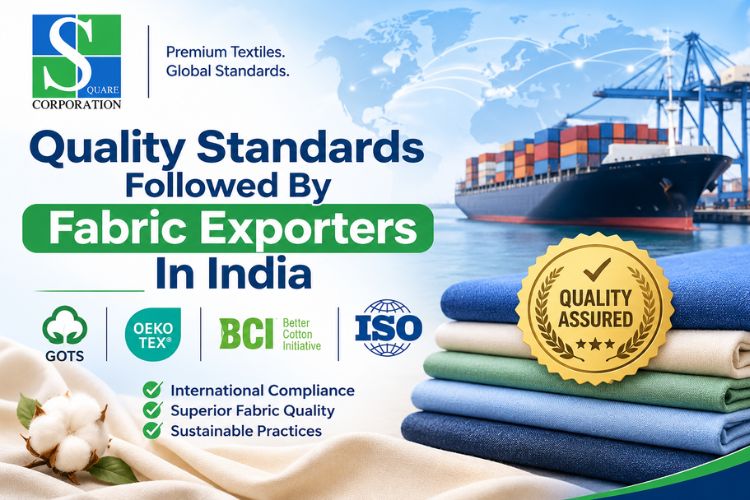
Quality is one of the most important factors international buyers consider when sourcing textiles. Reliable fabric exports depend on more than appearance: fibre composition, fabric construction, colour performance, durability, chemical safety and consistency must all meet the agreed product specification.
Professional fabric exporters in India work with defined quality checks, suitable laboratory tests and documented production controls. However, there is no single certificate that automatically covers every fabric or export market. The correct requirements depend on the material, intended use, buyer specification and destination country.
Also Read: Why Pre-Shipment Inspections Are Vital for Quality Assurance in Textiles
1. Fabric Composition and Construction Checks
The first stage is confirming that the fabric matches the approved technical specification. Buyers and exporters commonly verify fibre content, yarn type, weave or knit structure, fabric width, weight and construction density.
- Fibre composition: Confirms whether the fabric contains cotton, polyester, viscose, linen or the specified blend.
- GSM and width: Checks fabric weight and usable width against the purchase specification.
- Construction: Reviews yarn count, ends and picks, knit structure and surface uniformity.
- Dimensional stability: Measures shrinkage or growth after the agreed washing or finishing process.
2. Physical Performance and Colour-Fastness Testing
Fabric must perform as intended after handling, manufacturing and regular use. The relevant tests depend on whether the material is intended for apparel, denim, sportswear, upholstery or home textiles.
| Test | What it evaluates |
|---|---|
| Tensile and tear strength | Resistance to pulling forces and tearing |
| Pilling and abrasion | Surface durability during rubbing and wear |
| Colour fastness to washing | Colour change and staining during laundering |
| Colour fastness to rubbing | Colour transfer during dry or wet rubbing |
| Light and perspiration fastness | Colour performance under relevant exposure conditions |
Indian Standards include IS 1969 (Part 1):2018 for tensile properties, aligned with ISO 13934-1, and IS/ISO 105 methods for colour-fastness testing. ISO 105-C06, for example, specifies methods for evaluating colour resistance to domestic and commercial laundering. The buyer should agree on the applicable method, test conditions and acceptable result before bulk production.
3. Chemical Safety and International Compliance
Physical quality alone may not be enough. Depending on the destination and end use, buyers may require checks for restricted azo dyes, formaldehyde, heavy metals, pH or other chemical substances.
For example, EU REACH Annex XVII restricts certain azo dyes that can release specified aromatic amines above 30 mg/kg in relevant textile articles intended for direct and prolonged skin contact. US buyers should also consider applicable textile labelling and flammability rules for the final product.
4. Understanding ISO, BIS, GOTS and OEKO-TEX
Different standards and certifications serve different purposes:
- ISO test methods: Define how a particular property, such as tensile strength or colour fastness, is measured. ISO 9001, by contrast, concerns a quality management system rather than certifying that each fabric roll meets a specification.
- BIS: Publishes Indian Standards and operates product certification schemes. BIS certification is generally voluntary unless a relevant Quality Control Order makes it compulsory for the specific product.
- GOTS: Covers certified organic textile processing, environmental and social criteria, and supply-chain integrity. Version 8.0 was released in 2026 and becomes fully effective on 1 March 2027.
- OEKO-TEX STANDARD 100: Tests certified textile articles for harmful substances. Its 2026 regulatory updates took effect on 1 June 2026.
These schemes are not interchangeable. Buyers should verify the certificate holder, product scope, validity and relevant processing stages rather than relying only on a logo or a general supplier claim.
5. Production Inspection and Export Documentation
Quality control should continue from raw-material approval to final packing. Exporters can use incoming-material checks, approved samples, in-process inspections, roll-wise examination and pre-shipment checks to identify problems early. A four-point fabric inspection system is one commonly used method for grading visible defects; its acceptance limits should be agreed by the buyer and supplier.
Before dispatch, buyers should request relevant laboratory reports, approved fabric specifications, inspection records, roll and lot identification, packing details and applicable certificates. For certified products, check that the certification and transaction documents match the goods being supplied.
6. Choosing a Reliable Fabric Export Partner
Look beyond price when comparing suppliers. Review their ability to maintain shade consistency, meet agreed specifications, handle repeat orders, trace material lots and provide the documentation required for your market. Buyers evaluating a Textile Exporter Punjab should also assess product range, sourcing capability and communication throughout the order cycle.
Square Corporation supplies woven, knitted and denim fabrics and offers textile solutions for domestic and international buyers. To discuss fabric type, blend, weight, finish and bulk requirements, explore Square Corporation’s fabric supply solutions.
Frequently Asked Questions
Are BIS certificates mandatory for every fabric exporter in India?
No. BIS certification is generally voluntary unless a specific Quality Control Order makes it compulsory for the product category concerned. Always check the current notification.
What are the most important tests for export fabric?
Common tests include GSM, width, dimensional stability, tensile strength, tear strength, pilling, abrasion and colour fastness. The exact test plan depends on the fabric and its end use.
Are GOTS and OEKO-TEX the same?
No. GOTS focuses on certified organic textile processing and supply-chain requirements, while OEKO-TEX STANDARD 100 focuses on testing articles for harmful substances.
What should buyers request before approving a bulk fabric order?
Request an approved sample, written technical specification, relevant test reports, inspection criteria, lot traceability details and valid certificates where applicable.
Also Read: Best Organic Cotton Producers for Global Buyers
Blog Development Credits
This article was planned, researched, and refined through advanced AI-assisted content development, followed by careful editorial review and SEO optimization by Square Corporation to ensure originality, clarity, and reader value.