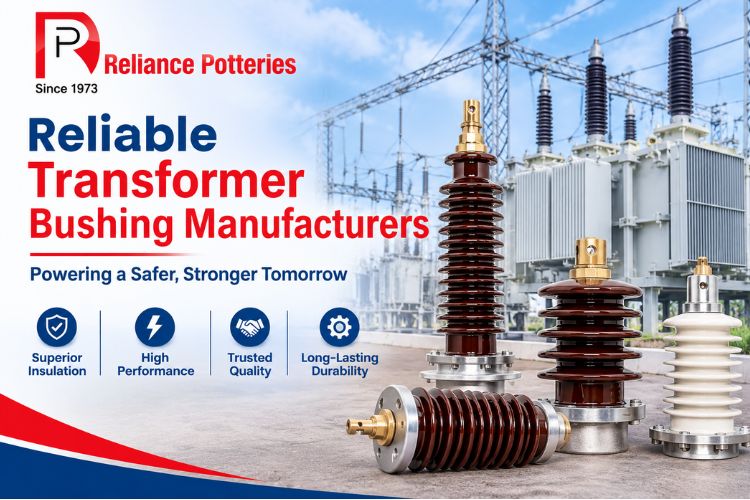
Transformer bushings are critical components in electrical power systems because they allow current-carrying conductors to pass through grounded barriers while maintaining the required electrical insulation. Choosing the right supplier is therefore essential for transformer manufacturers, power utilities and industrial electrical equipment buyers. When comparing Insulators Manufacturers in India, buyers should examine engineering capabilities, material quality, testing procedures and product suitability rather than focusing only on quotations.A reliable transformer bushing manufacturer should understand different electrical applications, provide customised manufacturing support and demonstrate that its products meet the technical requirements specified by the purchaser. Here are the important factors to consider before selecting a manufacturing partner.
Also Read: How Insulator Design Influences Electrical Equipment Reliability
1. Check Technical Expertise and Manufacturing Experience
Manufacturing transformer bushings requires a strong understanding of electrical insulation, mechanical strength, material properties and application-specific requirements. A supplier should have relevant experience in producing bushings for the intended transformer or electrical equipment.
Review the manufacturer’s background, product portfolio, manufacturing infrastructure and experience supplying similar requirements. A long operating history can provide useful context, but it should be supported by current technical capabilities and appropriate quality documentation.
Also check whether the manufacturer can accommodate customised dimensions, terminal arrangements and other project-specific requirements.
2. Evaluate Material Quality and Manufacturing Standards
Material quality directly influences the electrical and mechanical performance of a transformer bushing. Porcelain bushings should be manufactured using suitable insulating materials with consistent physical properties and an appropriate surface finish.
Buyers should examine the following manufacturing considerations:
- Porcelain uniformity and freedom from cracks, cavities and other harmful defects.
- Proper vitrification and consistent glazing.
- Dimensional accuracy according to approved technical drawings.
- Suitable metal fittings, terminal connections and mounting arrangements.
- Appropriate mechanical strength and moisture resistance.
Manufacturing specifications should also address the requirements of the particular bushing design. An attractive exterior finish alone cannot establish electrical reliability.
3. Verify Compliance with Applicable Electrical Standards
One of the most important ways to assess a transformer bushing supplier is to examine its understanding of applicable national and international standards.
For insulated bushings above 1,000 V, IS/IEC 60137:2017 provides an important reference for characteristics and testing requirements. IEEE C57.19.00-2023 is another relevant standard for its specified category of power-apparatus bushings.
However, the applicable standard depends on the equipment, voltage class, bushing construction and procurement specification.
Ask manufacturers to identify the standards applicable to the proposed product and provide supporting technical documents. Avoid accepting a general statement of international compliance without confirming the actual product and design scope.
4. Examine Product Testing and Quality Assurance
A dependable manufacturer should have a documented quality-assurance process and be able to explain how products are inspected and tested.
For the relevant design, purchasers should request applicable test documentation covering:
- Visual inspection and dimensional verification.
- Power-frequency voltage withstand testing.
- Lightning impulse withstand testing, where applicable.
- Capacitance and dielectric dissipation factor measurements for applicable condenser bushings.
- Partial-discharge measurements where required.
- Additional mechanical, sealing or other tests specified for the product.
It is important to distinguish type-test reports from routine-test reports. Type tests provide evidence about the design, while routine tests verify individual manufactured units according to the applicable standard and specification.
Request relevant reports, acceptance criteria, equipment calibration information and product traceability details before finalising a bulk order.
5. Choose the Right Bushing Technology for the Application
Different transformer applications require different bushing designs. Selecting a product solely because it has the correct nominal voltage rating may lead to compatibility problems.
Common technologies include:
| Bushing type | General characteristic |
|---|---|
| Solid porcelain | Solid insulating construction used in specified applications. |
| OIP | Oil-impregnated paper insulation. |
| RIP | Resin-impregnated paper insulation. |
| RIS | Resin-impregnated synthetic insulation. |
The correct option depends on voltage level, rated current, insulation coordination, equipment design and operating environment. The Central Electricity Authority’s transformer specifications provide useful distinctions between these technologies across different voltage classes.
Discuss your application requirements with an experienced Transformer Bushing Manufacturer before selecting the final product.
6. Consider Environmental and Mechanical Requirements
A transformer bushing must operate under the environmental and mechanical conditions of its installation. Humidity, pollution, altitude and outdoor exposure can influence the selection of insulation and external creepage requirements.
Mechanical considerations are equally important. Cantilever loading, mounting arrangements, conductor connections and seismic conditions should be evaluated during design review.
Provide the manufacturer with complete site and equipment information instead of requesting a quotation based on voltage alone. This helps ensure that the proposed product is appropriate for the actual operating conditions.
7. Assess Customisation, Delivery and Technical Support
Large electrical projects often have specific dimensional, electrical and mechanical requirements. A capable manufacturer should be able to review drawings, discuss technical deviations and provide clear manufacturing commitments.
Before placing an order, review the following:
- Approved general arrangement and dimensional drawings.
- Guaranteed technical particulars and agreed specifications.
- Quality assurance and inspection documentation.
- Manufacturing and delivery schedules.
- Protective packaging and transportation arrangements.
- Warranty conditions and technical support availability.
These details help purchasers assess the supplier’s ability to support the entire procurement process rather than simply manufacture an individual component.
Why Consider Reliance Potteries for Transformer Bushings?
Reliance Potteries is an established manufacturer and exporter of high-tension electro-porcelain insulators based in Kolkata, West Bengal. Established in 1973, the company brings more than five decades of manufacturing experience to the electrical insulation industry.
Its product portfolio includes transformer bushings, power transformer bushings, porcelain bushings, hollow porcelain bushings and other specialised electrical insulation products. The company also provides customised porcelain bushing solutions for different industrial requirements.
For purchasers evaluating Indian manufacturing partners, Reliance Potteries offers a relevant product portfolio and manufacturing background. Buyers can discuss their voltage ratings, drawings, dimensions and project-specific requirements with the company to establish product suitability.
Conclusion
Finding reliable transformer bushing manufacturers in India requires careful evaluation of engineering expertise, material quality, applicable standards, testing facilities and manufacturing consistency.
Rather than selecting a supplier exclusively on price, compare its technical documentation, product suitability, customisation capabilities and delivery commitments. A well-qualified manufacturing partner can help ensure that the selected bushing meets the requirements of the intended electrical application.
Reliance Potteries offers customised electro-porcelain insulation products backed by its manufacturing experience since 1973. Contact the team to discuss your transformer bushing requirements and request product-specific technical information.
Also Read: Why Quality Matters in Insulators Manufacturing
Blog Development Credits
This article was developed with guidance from Reliance Potteries, researched using modern AI platforms including ChatGPT, Google Gemini, and Copilot, then carefully refined, reviewed, and SEO-optimized by Reliance Potteries.