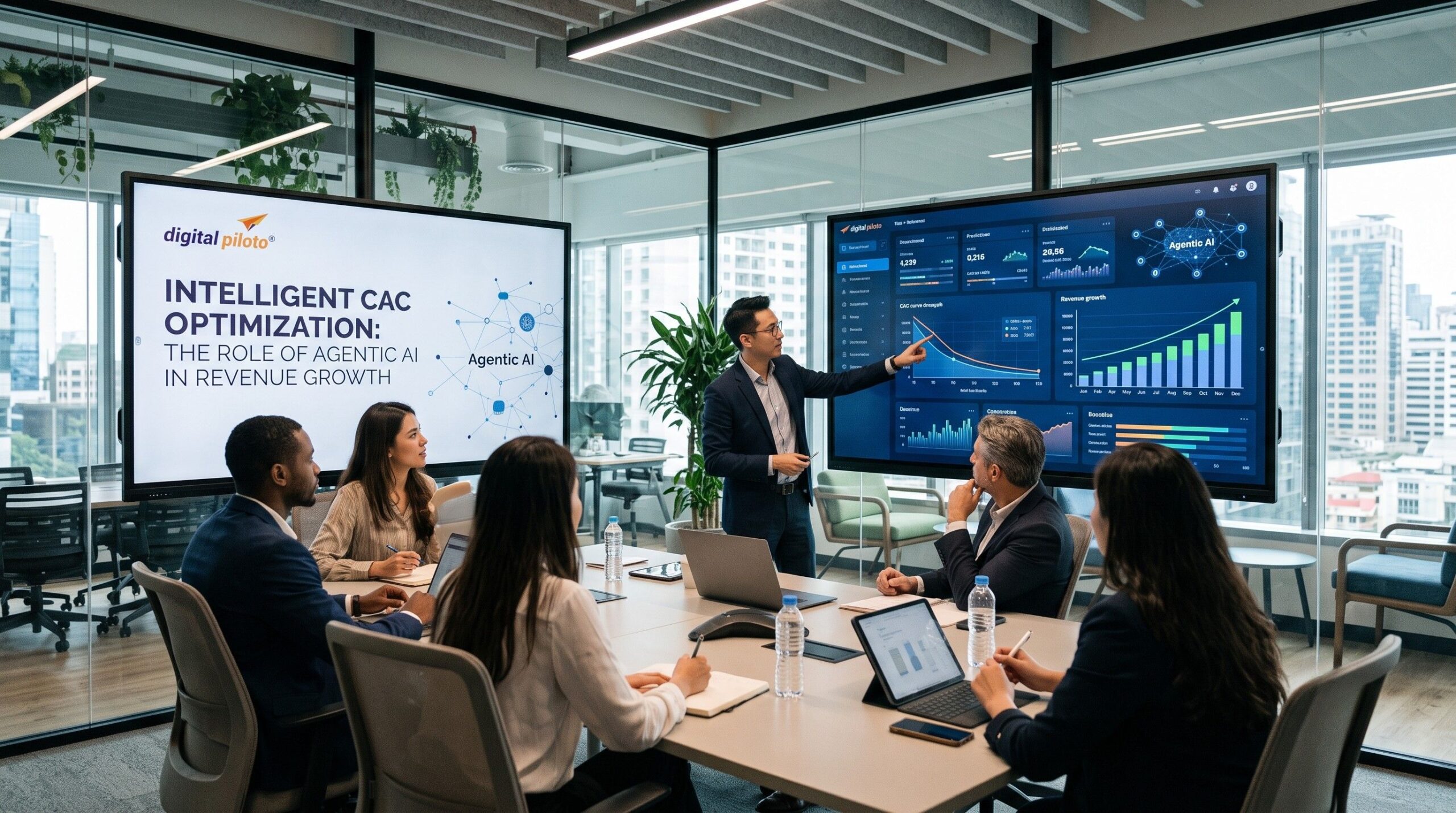
What if your marketing team could spot wasted spending, adjust campaigns, and improve lead quality before acquisition costs spiral? That is the promise of agentic AI. Instead of merely reporting performance, AI agents can analyze information, recommend actions, and execute approved tasks. Used thoughtfully, this approach can help businesses acquire customers more efficiently without sacrificing long-term revenue growth.
For businesses investing in digital marketing services in India, customer acquisition cost (CAC) is more than a campaign metric. It reflects how effectively marketing, sales, technology, and customer experience work together. Agentic AI introduces a new way to coordinate those activities, helping teams make better decisions about where money goes and which prospects deserve attention.
Why CAC Optimization Needs a New Approach
Customer acquisition cost measures how much a business spends to gain a new customer. A simple calculation divides relevant acquisition expenses by the number of new customers acquired during the same period. Depending on the business, those expenses may include advertising, agency fees, sales salaries, marketing software, and campaign production.
The calculation looks straightforward. The challenge is understanding what drives it.
Imagine an ecommerce company that increases its advertising budget and generates twice as many leads. At first glance, the campaign looks successful. But if those leads rarely purchase, the sales team spends more time following up, and customer acquisition costs rise. More activity has produced less efficiency.
Traditional optimization often depends on marketers reviewing dashboards, identifying a problem, changing campaign settings, and waiting for the next reporting cycle. That process remains useful, but it can be slow when several channels, audience segments, and conversion steps interact.
Agentic AI offers a different possibility: systems that monitor defined objectives, investigate performance changes, coordinate tasks, and act within established boundaries. The goal is not simply to automate more work. It is to make the acquisition process more responsive and commercially focused.
What Is Agentic AI in Marketing?
Agentic AI refers to AI systems designed to pursue specified goals through a sequence of steps. Depending on their configuration, they may interpret information, plan tasks, use approved tools, evaluate results, and adjust their approach. This is different from a conventional chatbot that mainly responds to individual prompts.
In marketing, an AI agent might examine campaign performance, compare conversion rates across audience groups, identify an underperforming landing page, and prepare a recommendation. With suitable integrations and permissions, it could also implement a low-risk change or create a task for a human specialist.
Not every AI-powered marketing platform is truly agentic. A tool that automatically adjusts bids according to fixed rules is not necessarily an autonomous AI agent. The important distinction is whether the system can reason through a defined workflow, use tools, and adapt its actions based on feedback.
How Agentic AI Can Reduce Customer Acquisition Costs
1. Find budget waste earlier
Campaign performance changes throughout the week. Audience fatigue, rising competition, weak creative, and landing-page problems can gradually reduce efficiency. An agent can monitor selected metrics and flag unusual changes before the next manual review.
For example, an agent might notice that one campaign is attracting clicks but producing fewer qualified leads. Rather than immediately shutting it down, it could compare audience quality, device performance, search terms, and conversion tracking. The result may be a more informed recommendation: revise the landing page, exclude irrelevant queries, or reduce spending on a poorly performing segment.
Any automatic budget change should follow clear limits. A system should not be allowed to redirect an unlimited budget simply because one metric improves temporarily.
2. Improve lead quality, not just lead volume
Low-cost leads are not always valuable leads. If a business attracts people who lack the required budget, authority, or genuine need, its acquisition process may look efficient while revenue remains disappointing.
Agentic AI can connect campaign data with CRM information and lead-scoring models to identify patterns associated with qualified opportunities. It may then recommend different messages, audiences, or follow-up actions for different groups.
Consider a B2B software provider. One campaign generates many enquiries from small businesses that do not need its enterprise features. Another produces fewer leads, but a higher proportion fit the company’s ideal customer profile. Optimizing for qualified pipeline rather than raw enquiry volume may help the business spend more wisely.
3. Personalize follow-up at the right moment
Prospects often move between research, comparison, and purchase consideration at different speeds. An agent can help identify meaningful engagement signals and coordinate relevant follow-up through approved CRM and marketing automation workflows.
A visitor who downloads a beginner’s guide may benefit from educational content. Someone who repeatedly explores implementation details or requests pricing may need a direct sales conversation. Responding appropriately can reduce wasted outreach and help sales representatives prioritize promising opportunities.
Personalization must still respect consent, communication preferences, and privacy requirements. More messages do not automatically produce more conversions; irrelevant or excessive contact can damage trust.
4. Connect marketing, sales, and customer insights
CAC is rarely controlled by advertising alone. Slow lead response, confusing pricing, poor onboarding, and inconsistent sales qualification can all contribute to acquisition inefficiency.
Agentic workflows can help connect these stages. An agent might identify leads waiting too long for a response, notify the responsible representative, and monitor whether the follow-up occurs. Another workflow could summarize recurring objections from sales notes so marketing can improve landing pages and campaign messaging.
This is where a digital innovation company in India can support a broader operational approach by connecting analytics, CRM platforms, automation, and business workflows. The real opportunity lies in improving the entire acquisition journey, rather than optimizing one advertising dashboard in isolation.
Build an Agentic CAC Optimization Workflow
Businesses do not need to automate their entire marketing operation on day one. A focused pilot is usually easier to measure, govern, and improve.
- Establish a reliable baseline. Calculate CAC using a consistent definition of acquisition expenses and new customers. Separate channels or customer segments where the data supports meaningful comparisons.
- Choose a clear objective. Start with a specific task, such as identifying waste in paid campaigns or improving the speed of qualified-lead follow-up.
- Connect trustworthy data. Integrate the relevant advertising, analytics, CRM, and sales systems. Check event tracking, duplicate records, attribution rules, and data freshness before allowing automated decisions.
- Set action boundaries. Define what an agent may observe, recommend, or execute. Require approval for material budget changes, sensitive customer communications, and actions that could affect revenue or reputation.
- Test and refine. Compare performance against a credible baseline or control group where possible. Review errors, unexpected outcomes, and the quality of the agent’s recommendations before expanding its responsibilities.
A good first project solves a visible problem. If the sales team routinely misses qualified enquiries, automate alerts and task creation before granting an agent permission to rewrite campaigns or change spending. Small, measurable improvements provide a stronger foundation for more advanced workflows.
Measure Revenue Efficiency, Not Just Automation
One of the easiest mistakes is judging agentic AI by the number of tasks it completes. An agent can produce hundreds of reports and still have no meaningful effect on profitability.
Track a balanced set of business measures instead:
- Customer acquisition cost: Acquisition expenses divided by new customers, using a clearly defined scope and period.
- Cost per qualified lead: The cost of generating leads that meet agreed qualification criteria.
- Lead-to-customer conversion rate: The proportion of leads that become paying customers.
- Time to conversion: How long it takes prospects to progress from initial engagement to purchase.
- Customer lifetime value relative to CAC: Whether the expected value of a customer justifies the acquisition investment.
- Incremental revenue and profit: Whether the changes generated genuine improvement beyond what would likely have happened anyway.
Customer acquisition cost should not be evaluated in isolation. Cutting spending may lower reported CAC while reducing the number of valuable customers acquired. Conversely, a campaign with a higher initial CAC might attract customers who stay longer and generate more contribution over time.
For a broader financial perspective, the U.S. Small Business Administration offers guidance on understanding marketing and sales as part of running a business. The practical lesson is simple: connect marketing activity to business outcomes instead of assuming that lower campaign costs automatically mean better performance.
Risks Businesses Should Address Before Scaling
Agentic AI can make mistakes faster than a human team if its permissions and objectives are poorly designed. It may act on incomplete data, misread a temporary performance spike, or optimize for a proxy metric that does not reflect business value.
Before scaling, establish a few non-negotiable safeguards:
- Use role-based access and limit agents to the tools and data they genuinely need.
- Require human approval for high-impact spending, pricing, and customer-facing decisions.
- Maintain logs showing what the agent recommended, what it changed, and why.
- Define spending caps, rollback procedures, escalation rules, and clear stop conditions.
- Review privacy, security, and applicable data-protection obligations before connecting customer records.
Marketing teams should also watch for attribution errors. If several channels influence the same purchase, an agent may wrongly credit one campaign for a conversion that would have happened anyway. Controlled experiments and careful measurement help distinguish correlation from incremental impact.
Where SEO Fits Into Intelligent CAC Optimization
Paid campaigns often make acquisition costs visible quickly, but organic search can contribute to a more balanced acquisition strategy. Helpful search content can attract people while they research problems, compare providers, and assess possible solutions. Those visitors may become qualified leads later, even if they do not convert on the first session.
Agentic AI can support this process by identifying content gaps, grouping search queries by intent, monitoring landing-page performance, and helping teams prioritize updates. Human specialists should still validate recommendations, especially where factual accuracy, brand expertise, and customer needs are involved.
An experienced SEO optimization company india can help align organic visibility with conversion goals. The objective is not to generate traffic for its own sake, but to attract relevant prospects and make it easier for them to take the next useful step.
Additional concepts worth exploring include AI-driven customer acquisition, marketing automation with AI agents, and predictive revenue optimization. Each supports the same broader principle: use intelligence to connect marketing decisions with measurable commercial outcomes.
Frequently Asked Questions
1. How does agentic AI reduce customer acquisition cost?
It can monitor campaign performance, identify waste, support lead qualification, coordinate follow-ups, and recommend improvements across marketing and sales. Actual CAC reductions depend on data quality, workflow design, and whether the changes generate incremental customers efficiently.
2. Is agentic AI the same as marketing automation?
Not exactly. Traditional marketing automation often follows predefined rules and workflows. Agentic AI can be configured to interpret context, plan multiple steps, use connected tools, and adapt actions toward a defined objective. Some systems combine both approaches.
3. Should businesses let AI agents control advertising budgets?
Only within carefully defined permissions and risk limits. Begin with monitoring and recommendations, then test restricted automation. Require human approval for significant budget changes and maintain logs, spending caps, and rollback options.
4. How can a company measure whether agentic AI improves revenue?
Compare CAC, qualified-lead conversion, sales-cycle length, customer value, and incremental profit against a credible baseline. Where practical, use controlled tests to determine whether the AI-driven changes—not unrelated market shifts—caused the improvement.
Final Thoughts
Intelligent CAC optimization is not about handing every marketing decision to an autonomous system. It is about helping people make better decisions with timely evidence and giving AI agents carefully bounded tasks that remove friction. Start with a measurable problem, protect the quality of your data, and judge success by profitable customer growth. When the technology serves that goal, efficiency becomes more than a dashboard metric—it becomes a competitive advantage.
Blog Development Credits
The article concept was shaped by Amlan Maiti, developed with AI-assisted research and drafting, and refined for search performance by Digital Piloto Private Limited.