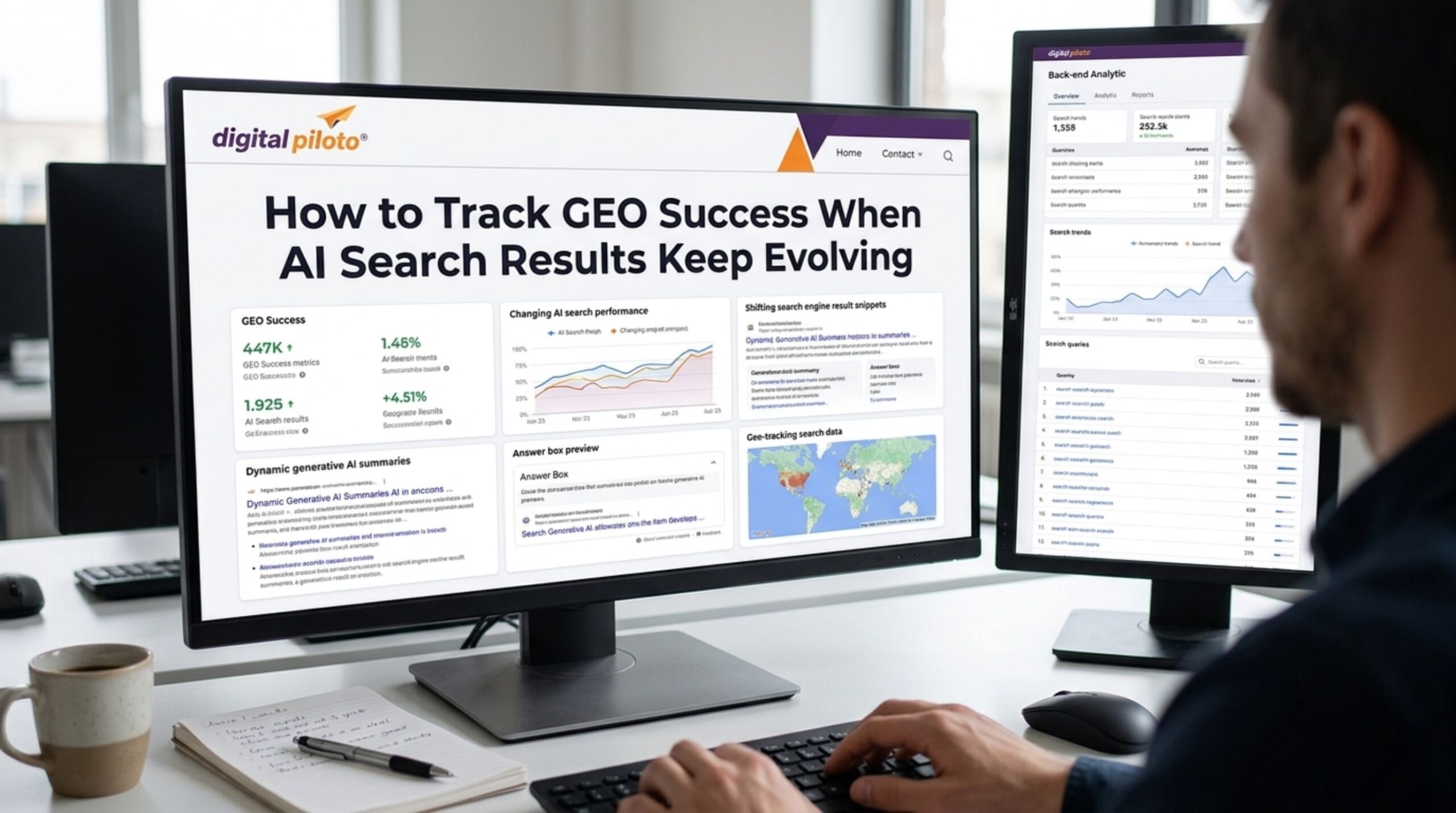
AI search does not behave like a traditional ranking page. The same question can produce different answers, sources, and brand mentions from one moment to the next. So how do you know whether GEO is actually working? The answer is not another vanity score. It is a measurement framework built around visibility, citations, brand demand, and real business outcomes.
Why GEO Measurement Is Different
Traditional SEO gives marketers a comforting illusion of stability. A keyword has a position. A page has impressions. A website gets clicks. You can open a report on Monday and compare it with last month.
Generative search is messier.
Ask an AI-powered search engine the same question twice and you may see different wording, different supporting sources, a different ordering of recommendations, or even different brands. Location, context, freshness, query wording, personalization, and the underlying retrieval process can all influence what appears.
That does not make GEO impossible to measure. It simply means marketers need to stop thinking about GEO as a conventional keyword-ranking exercise.
Google’s current documentation is useful here. Its generative AI search features are built on core Search systems, including retrieval techniques that use information from Google’s index to ground responses. Google also says that established SEO fundamentals remain relevant for AI Overviews and AI Mode.
In other words, GEO measurement should connect two worlds: the traditional search data you already understand and the new signals emerging from AI-generated discovery.
First, Define What GEO Success Means
Before opening a dashboard or buying an AI visibility tool, decide what success actually means.
For one business, success may mean appearing whenever customers ask AI about a particular service category. For another, it could mean getting cited as a source for technical questions. An ecommerce brand may care more about product recommendations, while a B2B company might care about being included in vendor comparisons.
A useful GEO objective usually has four layers:
- Presence: Does the brand appear for important AI-search questions?
- Association: Is the brand connected with the right topics, services, products, locations, and expertise?
- Evidence: Are the brand’s pages or other credible sources cited when relevant?
- Outcome: Does increased visibility contribute to branded searches, enquiries, sales opportunities, or revenue?
This distinction matters. A company could receive hundreds of AI mentions and still attract the wrong audience. Another company might appear less frequently but consistently show up for high-intent commercial questions. The second situation may be far more valuable.
Track AI Visibility as a Pattern, Not a Position
One of the most common GEO measurement mistakes is asking, “What position are we in?”
That question comes from traditional SEO.
AI search often does not have a single equivalent position. A brand might appear in the first sentence, halfway through a recommendation list, inside a citation, or only after a follow-up question.
Instead, create a GEO query set.
Select a stable group of questions that represent your customers’ real journeys. Include informational, commercial, comparison, local, and problem-solving queries.
For example, a digital marketing business might monitor questions such as:
- Which digital marketing companies help Indian businesses grow online?
- What should a business look for in an SEO partner?
- Which agencies specialize in AI search optimization?
- How can an Indian company improve visibility in generative search?
- What are the best ways to measure GEO performance?
Run these queries on a consistent schedule and record what happens. Do not expect identical answers every time. The variation itself is useful information.
What should you record?
For each query, capture the date, platform, location where relevant, wording of the query, whether your brand appeared, how it appeared, which competitors appeared, and which sources were cited.
You can then calculate a simple AI visibility rate:
AI Visibility Rate = Queries where the brand appears ÷ Total tracked queries × 100
This is not a Google ranking metric. It is your own monitoring measure. That distinction should remain clear in every report.
Measure Citation Quality, Not Just Citation Count
Being cited is useful. Being cited in the right context is much more useful.
Imagine two companies mentioned 50 times each. Company A is cited mostly for generic information. Company B is cited repeatedly when users ask which provider, product, or solution they should consider.
Equal citation counts. Very different commercial value.
That is why GEO reporting should examine citation quality.
Ask:
- Was the citation connected to a commercially relevant question?
- Was the brand represented accurately?
- Was the source page actually relevant to the claim?
- Did the AI system describe the company using the positioning you want?
- Were competitors presented as more authoritative alternatives?
This last point is particularly revealing. GEO is not simply about getting mentioned. It is about becoming associated with the subjects and decisions that matter to your business.
Use Search Console as Your Foundation
Here is where GEO measurement becomes more concrete.
Google introduced dedicated Search Console reporting for generative AI features in 2026. The reports provide visibility into impressions from generative AI features such as AI Overviews and AI Mode, along with information about pages, countries, devices, and performance over time. Google announced that these insights had been rolled out to all websites worldwide by August 31, 2026.
That is a significant development because marketers no longer have to treat every AI-search measurement question as completely separate from first-party search data.
However, do not confuse impressions with business success.
An impression tells you that visibility occurred. It does not tell you whether the right person noticed it, trusted it, or eventually bought from you.
Use Search Console as one layer of the measurement stack, then connect it with analytics, CRM and sales data.
Watch the Relationship Between Impressions and Clicks
This is where things can get interesting.
You might see AI-related visibility increase while organic clicks remain flat—or even decline. That does not automatically mean the GEO strategy failed.
AI answers can satisfy some informational needs without sending the user to a website.
Pew Research Center’s analysis of 68,879 Google searches in March 2025 found that traditional result links were clicked on 8% of visits when an AI summary appeared, compared with 15% when no AI summary appeared. Links within the AI summaries themselves were clicked in only about 1% of visits. The study covered a specific group of U.S. users and a defined period, so these figures should be interpreted as evidence of changing search behavior rather than a universal CTR benchmark.
That is precisely why a GEO report should never say, “Traffic is down, therefore visibility is down.” The two can move differently.
Track Branded Search as a Delayed Signal
One of the most useful indirect signals is branded demand.
Suppose a prospect sees your company mentioned in an AI answer on Tuesday. They do not click. On Wednesday, they search your company name directly. On Friday, they visit your website and request a consultation.
Last-click reporting might give most of the credit to the branded search.
That is understandable, but incomplete.
GEO can create demand that appears later through branded queries. So monitor:
- Branded impressions and clicks: Look for sustained changes rather than isolated spikes.
- Direct and returning traffic: Check whether more people are coming back without an obvious referral source.
- Lead quality: Ask sales teams whether prospects already know the company or its expertise when they enquire.
- Conversion paths: Look for AI visibility as an earlier influence before the final conversion event.
This is not proof of causation. Branded demand can rise for many reasons, including advertising, PR, social activity, offline marketing, seasonality, or market changes. But it becomes a valuable supporting signal when several indicators move together.
Build a GEO Measurement Scorecard
A practical scorecard should be simple enough to review every month without turning the marketing meeting into a spreadsheet endurance test.
A strong framework might include five categories.
1. Visibility
Measure the percentage of tracked prompts where your brand appears, along with visibility by topic, product, service and location.
2. Citation
Record how often your website or other authoritative brand-associated sources are referenced and whether those citations support commercially meaningful answers.
3. Competitive presence
Track which competitors appear alongside you and where they seem to have stronger associations. Sometimes the most useful GEO insight is discovering what another company owns in the AI answer landscape.
4. Brand demand
Monitor branded search impressions, clicks, direct visits, returning visitors and branded conversions.
5. Business outcomes
Ultimately, measure qualified leads, sales opportunities, purchases, customer acquisition and revenue. Visibility is the means, not the finish line.
For businesses working with a generative engine optimization company, this scorecard can also make monthly strategy discussions much more useful. Instead of saying “our GEO score improved,” the team can explain exactly what changed and whether the change matters commercially.
Do Not Overreact to One Strange AI Answer
This deserves its own section because AI search can make marketers nervous.
You run a query on Monday. Your brand appears.
You run it again on Tuesday.
Gone.
It is tempting to panic and rewrite five pages.
Don’t.
A single AI response is a snapshot. What matters is repeated observation.
Think of GEO monitoring like checking the weather. One gust of wind does not tell you the climate. You need a series of observations before deciding that something has genuinely changed.
Track weekly or monthly trends, depending on query volume and business importance. Record significant changes, but avoid rewriting content every time an AI response changes.
Google itself cautions website owners against relying on third-party tools that claim access to internal AI or ranking signals. Its guidance recommends using external tools as workflow aids while evaluating their advice against official Search guidance.
Look Beyond Text-Based Search
AI discovery is also becoming more multimodal.
Google announced in September 2026 that Search Console was adding reporting for web multimodal searches, including experiences involving Google Lens, Circle to Search, image uploads, and image-based searches. The new data is integrated into Search performance and generative AI reporting.
For some businesses, that means GEO measurement should eventually expand beyond typed prompts. Product imagery, visual explanations, diagrams, locations, videos, and other assets may all contribute to how a brand is discovered.
It is another reason not to build a measurement framework around one platform or one type of query.
What a Good Monthly GEO Report Looks Like
Keep the final report focused on decisions rather than decoration.
A useful monthly review should answer five questions:
- Where did our AI visibility improve?
- Where did it decline?
- Which topics or questions generated the strongest visibility?
- Which competitors or sources appeared more frequently?
- Did increased visibility coincide with stronger branded demand or business outcomes?
Then identify three actions for the following month.
Perhaps one service needs stronger supporting content. Perhaps competitors are being cited for questions your website barely addresses. Or perhaps your visibility is healthy, but the resulting branded traffic is not converting.
That last finding is valuable too. GEO cannot compensate for a weak offer, confusing website or poor conversion experience.
Frequently Asked Questions
What is the most important GEO metric?
There is no single universal GEO metric. A useful framework combines AI visibility, citation quality, competitive presence, branded demand and business outcomes. The right emphasis depends on the company’s goals.
Why do AI search results change so frequently?
Generative search can produce different responses based on query wording, retrieved sources, freshness, context and other factors. Therefore, GEO should be measured across repeated observations rather than one search result.
Can Google Search Console measure GEO performance?
Yes. Google introduced dedicated Search Console reporting for generative AI features, including visibility from experiences such as AI Overviews and AI Mode. The available reporting should be used alongside analytics and business data.
Should GEO reports include website traffic?
Absolutely. Traffic remains important, but it should be treated as one part of the measurement framework. AI visibility can influence users before they click, so branded demand, assisted conversions and qualified leads should also be considered.
Final Thoughts
GEO success is not a number that sits permanently beside your brand name. AI search keeps moving, and your measurement system needs to move with it.
The smartest approach is surprisingly grounded: establish a consistent query set, monitor visibility over time, evaluate citation quality, compare competitors, connect AI exposure with branded demand, and ultimately follow the trail to leads and revenue.
For a best digital marketing agency in India, that means GEO reporting should become less about chasing a perfect AI ranking and more about understanding whether the brand is becoming easier to discover, trust, remember, and choose.
AI answers may change tomorrow. Your measurement discipline should be strong enough to make sense of that change.
Blog Development Credit
The concept originated with Amlan Maiti, shaped through research and AI-assisted writing with ChatGPT, Gemini and Copilot, then polished by Digital Piloto Private Limited.