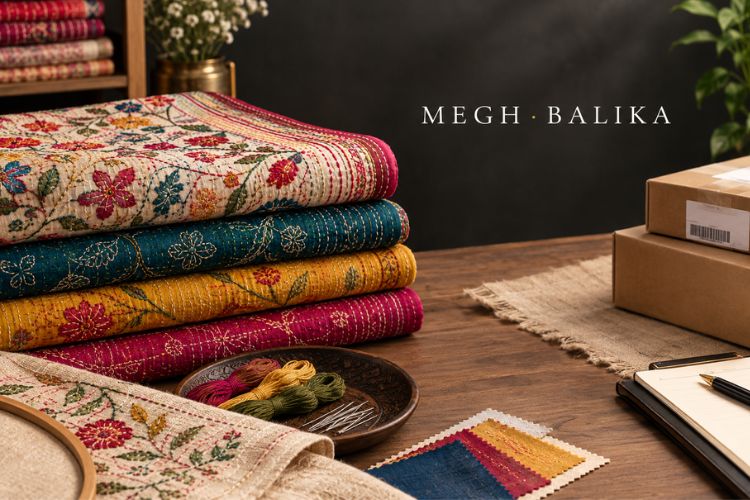
Choosing a reliable Kantha Stitch Wholesale USA supplier requires more than comparing product photos or unit prices. U.S. boutiques and retailers should examine craftsmanship, fabric specifications, sampling, MOQ, documentation, shipping, and the supplier’s ability to maintain consistent quality across repeat orders.
Understand What You Are Actually Buying
Kantha is a traditional Bengal embroidery style characterized by running stitches. India’s handicrafts authorities describe Nakshi Kantha as a Bengal textile tradition used across apparel and home textiles. The important buying question is therefore not simply whether a product is called “Kantha,” but how the item is constructed, where the base fabric comes from, and whether the embroidery is genuinely handcrafted.
Ask suppliers to specify the fabric, weaving method, embroidery technique, measurements, blouse-piece inclusion where applicable, care instructions, and country of origin.
Check These Seven Supplier Qualities
1. Product and Craft Transparency
A credible supplier should be able to explain the fabric composition, embroidery process, product dimensions, finishing and origin. Photos of both the front and reverse side of the embroidery can be especially useful when evaluating workmanship.
2. Sample Before Bulk Ordering
Never judge a wholesale program only from catalogue images. Order samples and inspect stitch consistency, loose threads, border finishing, fabric feel, color accuracy, drape and overall construction. For handmade products, small variations can occur, but your acceptable quality level should be defined before production.
3. MOQ and Assortment Flexibility
MOQ can differ significantly between suppliers and even between products. Confirm the minimum quantity per design, whether styles can be mixed, sample-order rules, reorder quantities and customization thresholds. A lower MOQ is not automatically better if the supplier cannot maintain consistency.
4. Quality-Control Process
Ask how products are inspected before dispatch. A useful wholesale specification should identify measurements, fabric composition, embroidery expectations, finishing standards and acceptable tolerances. Written specifications reduce misunderstandings when your first repeat order arrives.
5. U.S. Labeling and Product Information
For covered textile products, U.S. FTC rules generally require fiber content, country of origin and responsible business identification. Apparel also has care-label requirements. Imported textile products must also satisfy applicable U.S. customs marking requirements, while apparel can be subject to CPSC flammability standards.
Do not assume that a supplier’s phrase “export-ready” automatically answers every U.S. compliance question. Ask for the exact labeling and documentation applicable to the products you plan to import and sell.
6. Calculate Landed Cost
The wholesale unit price is only one part of your buying decision. Compare product cost, packaging, international freight, insurance where applicable, brokerage, duties and other destination charges to estimate your real landed cost. A supplier with a slightly higher product price may produce a more predictable total cost if documentation and logistics are clearer.
7. Evaluate Long-Term Supply Capability
A boutique needs more than one attractive shipment. Ask about lead times, repeat-order availability, customization, communication, production capacity and how new designs are approved. A supplier who can document processes clearly is easier to work with as your collection grows.
Which Wholesale Model Fits Your Business?
| Supplier Model | Potential Advantage | What to Check |
|---|---|---|
| U.S.-based wholesaler | Potentially simpler domestic fulfillment | Product origin, assortment and wholesale pricing |
| Direct India exporter | Closer access to Bengal craftsmanship and customization | Samples, export documents, freight and lead time |
| Wholesale marketplace | Convenient discovery and retailer purchasing tools | Brand-level policies, product consistency and origin |
Questions to Ask Before Placing a Wholesale Order
- What is the exact fabric composition and embroidery method?
- What is the MOQ per design and for reorders?
- Can I inspect or purchase samples first?
- What quality checks occur before dispatch?
- What labeling and origin information accompanies the product?
- What are the production and shipping lead times?
- What is included in the quoted price, and what destination costs remain?
Why Direct Product Verification Matters
Current Kantha wholesale listings show substantial variation in product types, MOQs and pricing, while specialist suppliers use different sourcing, fulfillment and wholesale models. That makes supplier verification more useful than relying on a generic “best supplier” label.
For U.S. buyers looking for Bengal-focused collections, Megh Balika presents Kantha sarees featuring hand Kantha embroidery from Bengal and provides export-oriented product information. Buyers can review the Kantha collection and request current catalogue, sample and commercial details.
Consider Related Bengali Textile Collections
If your boutique is building a wider Bengali textile assortment, a Jamdani Textile Supplier can complement a Kantha-focused collection with a different textile tradition and product story.
FAQ
What should U.S. buyers ask a Kantha wholesale supplier?
Ask about fabric composition, embroidery method, origin, MOQ, sample availability, quality control, lead time, labeling information and shipping terms.
Is a low MOQ always better?
No. MOQ should be considered together with quality consistency, customization options, pricing, lead time and reorder availability.
Should I buy samples before a wholesale order?
Yes. Samples let retailers evaluate workmanship, dimensions, fabric, color, finishing and consistency before committing to a larger order.
What U.S. requirements should textile importers check?
Depending on the product, buyers should review applicable FTC textile labeling, care-label, CBP country-of-origin and CPSC requirements before importing and selling.
Final Takeaway
The right Kantha wholesale supplier is the one whose craftsmanship, specifications, sampling, MOQ, documentation, logistics and communication fit your business requirements. For U.S. buyers, the most reliable sourcing process is evidence-led: verify the sample first, document the commercial terms, confirm applicable U.S. requirements, and calculate the landed cost before committing to volume.
Also Read: Top Premium Jamdani Sarees Wholesale Deals
Blog Development Credits
This article was thoughtfully developed by Megh Balika, supported by advanced AI research platforms including ChatGPT, Google Gemini, and Copilot, then carefully refined with original editing and SEO improvements by Megh Balika.