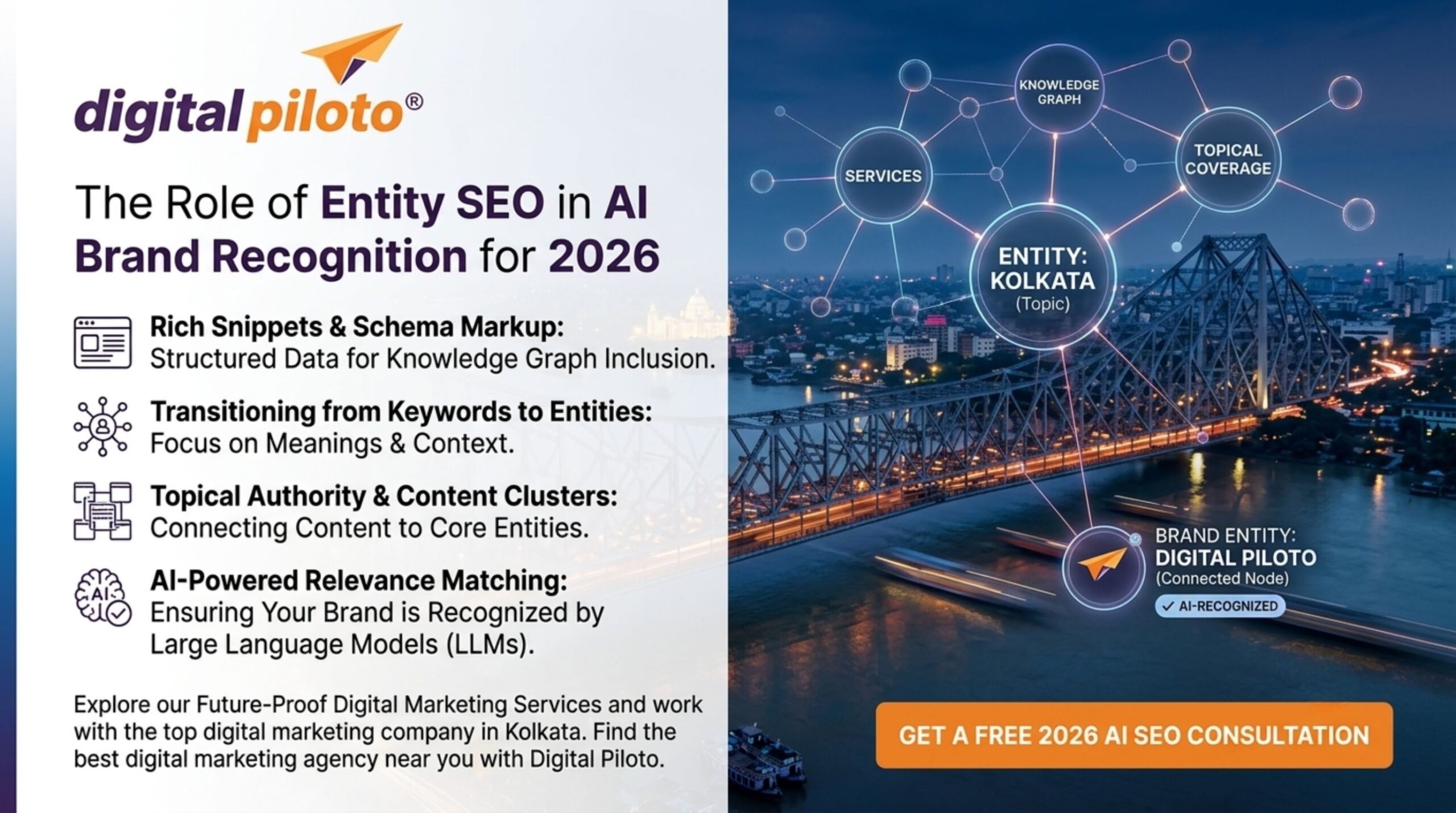
In 2026, being visible in search is no longer enough. AI systems increasingly interpret companies as entities, connect information from multiple sources, and help users decide which brands deserve attention. For businesses, that creates a new challenge: how do you make your identity clear enough for machines to understand, while remaining useful and credible enough for people to trust?
Why Entity SEO Matters More in 2026
Traditional SEO often begins with keywords. Entity SEO begins with meaning.
Consider a company that describes itself as a “full-service growth partner.” That sounds polished, but it tells a search system very little. Is it an advertising agency? A software company? A consultancy? Does it serve startups, enterprises, local businesses, or ecommerce brands?
A stronger digital presence answers those questions clearly. It establishes the business name, category, services, locations, people, expertise, relationships, and other attributes that help distinguish the organization from similar companies.
This matters because search itself is becoming more conversational and contextual. Google reported in 2026 that AI Mode had surpassed one billion monthly users globally, while AI Overviews had reached more than 2.5 billion monthly active users.
For a modern digital marketing agency in Kolkata, this means brand visibility can no longer be treated as a simple rankings exercise. The objective is increasingly to build a digital identity that humans and AI systems can interpret consistently.
What Is an Entity in SEO?
An entity is essentially a distinct, identifiable thing: a company, person, product, place, organization, event, or concept. Search engines can associate attributes and relationships with these entities rather than treating every occurrence of a word as an isolated keyword.
For example, a company entity might be connected with:
- Identity: company name, alternate names, logo, website, and legal details.
- People: founders, executives, authors, specialists, and other identifiable experts.
- Services: the specific products or solutions the organization provides.
- Location: offices, service areas, markets, and regional presence.
- External references: credible profiles, publications, partnerships, professional networks, and other relevant sources.
The goal is not to turn a website into a database of keywords. It is to make the underlying business easier to identify and distinguish.
Google’s Organization structured-data documentation specifically explains that organization markup can help Google understand administrative details and disambiguate an organization in Search. It recommends useful properties such as name, URL, logo, address, telephone, and applicable external profiles through sameAs.
Entity SEO Is About Relationships, Not Just Names
This is where entity SEO gets interesting.
Imagine that a search system understands a business as more than its homepage. It can connect the company to its founder, its services, its geographic market, its published expertise, its products, and independent references elsewhere on the web.
Those relationships create context.
Suppose someone searches for “enterprise SEO services in Kolkata.” A brand that has only a generic homepage and a handful of keyword-focused landing pages gives a system limited information. A business with detailed service pages, expert authors, local information, case studies, relevant publications, and consistent company profiles creates a much richer picture.
This does not guarantee visibility or recommendation. Search systems use many signals, and AI responses can vary by query and context. But clear relationships give machines better information from which to understand the brand.
From Keywords to Knowledge Structures
There was a time when marketers could build an article around a keyword, use the phrase several times, add a few related terms, and call the job done.
That approach is increasingly fragile.
Imagine a customer researching “best CRM for a growing manufacturing company.” The important concepts are not just the words CRM and manufacturing. The system needs to understand company size, industry requirements, workflows, integrations, implementation complexity, pricing considerations, and perhaps regional compliance.
Entity-focused content addresses those relationships naturally.
A useful page might explain which features matter for manufacturers, compare deployment models, discuss integration requirements, identify common implementation problems, and connect those issues to the company’s actual solution.
That is much closer to how people make decisions—and increasingly closer to how conversational search experiences help them explore a topic.
The Connection Between Entity SEO and AI Brand Recognition
AI brand recognition should not be confused with brand popularity.
A company can be famous yet poorly understood in a particular category. Conversely, a smaller specialist can have a highly coherent digital identity around a narrow subject.
Recognition becomes useful when a system can answer questions such as:
- What is this company?
- What does it actually provide?
- Who is it designed to serve?
- Where does it operate?
- What topics or problems is it associated with?
- Which people or organizations are connected to it?
- What independent evidence supports its expertise?
When those answers remain consistent across a company’s website and relevant external sources, the brand’s identity becomes easier to interpret.
Google’s current AI Search developments reinforce the broader direction. Its 2026 updates emphasize helping users discover relevant websites, original content, and trusted sources within AI Overviews and AI Mode.
Build a Strong Entity Foundation on Your Website
Before worrying about AI visibility, businesses should get their own house in order.
Make the organization unmistakable
Your About page should not be a vague paragraph about being “passionate innovators.” Explain who the company is, what it does, where it operates, whom it serves, and what distinguishes its expertise.
Connect people to expertise
Author pages and expert profiles can help establish who is responsible for the information being published. A founder discussing entrepreneurship, an engineer explaining a technical process, or a doctor writing within their professional expertise provides useful context.
Clarify products and services
Each important offering should have its own clear explanation. Avoid forcing unrelated services onto one oversized page simply because they share a keyword.
Use structured data appropriately
Structured data can provide machine-readable context. Google recommends using the most specific applicable Organization subtype and adding relevant information such as names, addresses, logos, URLs, and contact details.
Importantly, structured data is not a magic switch for AI recognition. It supports understanding; it does not guarantee rankings, citations, or inclusion in an AI answer.
External Signals Strengthen Entity Understanding
A brand should not exist only on its own website.
Think about how you would verify a new business in the real world. You might check its website, professional profiles, customer reviews, industry mentions, business directories, news coverage, or the people associated with it.
Search systems can also encounter a brand through multiple sources.
That makes consistent external information valuable. Relevant third-party references can reinforce the relationship between a company and its areas of expertise.
Useful external signals can include:
- Industry publications mentioning the business or its experts.
- Professional profiles belonging to identifiable team members.
- Legitimate business directories and local profiles.
- Customer reviews and independent experiences.
- Podcasts, interviews, conferences, webinars, and expert contributions.
- Partnerships or associations that are genuinely relevant to the organization.
The emphasis should be on relevance and authenticity. Publishing a company’s name on hundreds of low-quality websites does not create meaningful authority.
Why Local Entity SEO Matters for Indian Businesses
Entity SEO becomes particularly practical for businesses operating in specific cities or regions.
A company targeting Kolkata, for example, should make its local identity clear instead of scattering “Kolkata” across every paragraph. Location information can be supported through an appropriate business profile, contact details, service-area information, local content, reviews, and consistent organizational data.
Google’s Local Business structured-data documentation explains that this markup can provide information such as business hours, departments, and other local details, helping Search understand the business represented by a page.
For a business investing in SEO service, this local entity layer can complement conventional organic optimization.
Where a Generative Engine Optimization Agency Fits
The rise of AI-assisted discovery has created a new strategic layer around entity SEO.
A generative engine optimization agency may assess how clearly a brand is represented across AI-oriented search journeys, including whether important questions about the company can be answered from reliable sources.
But good GEO should not become a collection of tricks.
There is no dependable formula that forces ChatGPT, Gemini, Google AI Mode, or another system to mention a particular company. AI outputs can change according to the query, model, location, available sources, and user context.
A more durable approach is to strengthen the underlying information ecosystem: clear entities, original expertise, useful content, accurate business information, strong technical foundations, and credible external references.
Entity SEO and Original Content Work Together
Entity optimization becomes much stronger when the content attached to the entity is genuinely useful.
Google has recently emphasized original content and firsthand perspectives in AI Search, including features designed to help users discover sources and influential coverage. Its 2026 updates introduced Preferred Sources in AI Overviews and AI Mode and added “Highly Cited” labels for some web articles.
This creates an interesting opportunity for specialist businesses.
You do not necessarily need to publish the most content. You need to publish information that adds something.
A manufacturer can share production insights. A SaaS company can publish implementation lessons. A law firm can explain recurring regulatory questions within its expertise. A marketing agency can document patterns it sees across campaigns.
Those details create associations that generic articles cannot easily replicate.
How to Audit Your Brand Entity in 2026
A practical entity audit can begin with a simple question: “If an AI system had to describe our company without seeing our homepage, would the description still be accurate?”
Then check:
- Name consistency: Is the company name presented consistently across important properties?
- Category clarity: Can someone immediately understand what the company does?
- Service relationships: Are the main products and services clearly connected to the organization?
- People: Are founders, authors, and subject-matter experts identifiable?
- Location: Are physical locations and service areas accurate?
- External corroboration: Do credible sources reinforce important claims?
- Content depth: Does the site demonstrate actual expertise or mainly repeat generic information?
- Technical accessibility: Can search engines crawl and index the important information?
This kind of audit is more useful than simply asking whether a company has “done entity SEO.” Entity optimization is not a one-time checkbox. It is an ongoing effort to keep the organization’s digital identity accurate as the business evolves.
What Changes for B2B and B2C Brands?
For B2B companies, entity clarity can support long consideration cycles. Buyers may research a company, its leadership, technology, partners, industry expertise, case studies, and competing solutions before contacting sales.
B2C businesses have a different challenge. Product attributes, reviews, availability, brand reputation, location, and customer experience may influence how a recommendation is formed.
In both cases, the principle is similar: make the brand easier to understand in context.
That means moving beyond a website designed purely around conversion and creating an information ecosystem that answers the questions customers—and the systems assisting them—actually ask.
Measuring AI Brand Recognition
There is currently no universal industry metric called an “entity SEO score” that reliably predicts AI visibility. Be wary of vendors presenting one number as the definitive measure of brand recognition.
Instead, businesses can monitor several directional indicators:
- Whether AI systems accurately describe the company.
- Whether the brand appears for relevant category and problem-based questions.
- Whether important products or services are associated with the correct company.
- Whether AI responses link to or reference authoritative brand content when appropriate.
- Whether third-party sources consistently describe the company.
- Whether AI-assisted discovery contributes to qualified traffic and business enquiries.
Google has also introduced new website-owner tools and Search Console insights intended to help publishers understand performance in generative AI search experiences.
These measurements should be interpreted over time. One prompt producing one result is not enough to establish a trend.
Frequently Asked Questions
What is Entity SEO?
Entity SEO is an approach to search optimization that focuses on helping search systems understand distinct entities—such as companies, people, products, organizations, and locations—and the relationships between them.
Why is Entity SEO important for AI search?
AI search systems often need to interpret entities and context before generating an answer. A clear and consistent digital identity gives systems better information for distinguishing a brand and understanding what it represents.
Does Schema Markup improve AI brand recognition?
Structured data can help search engines understand specific information about an organization, product, or local business. However, it does not guarantee rankings, AI citations, or recommendations. It should support a broader SEO and content strategy.
Can Entity SEO replace traditional SEO?
No. Entity SEO complements traditional SEO. Crawlability, indexing, technical quality, useful content, internal linking, relevance, and other foundational practices remain important for search visibility.
Final Thoughts
Entity SEO may sound technical, but its underlying idea is surprisingly human: make it easy for others to understand who you are, what you know, what you offer, and why your information deserves attention.
In 2026, that clarity matters across both traditional search and AI-assisted discovery. Brands that build coherent identities, demonstrate genuine expertise, maintain accurate information, and earn credible references will be better positioned for a search environment where machines increasingly help people decide what to explore next.
The future of brand recognition is therefore not just about being found. It is about being understood correctly.
Blog Development Credits
This article was conceived by Amlan Maiti, AI-assisted research supported development, and Digital Piloto Private Limited completed the final SEO refinement.