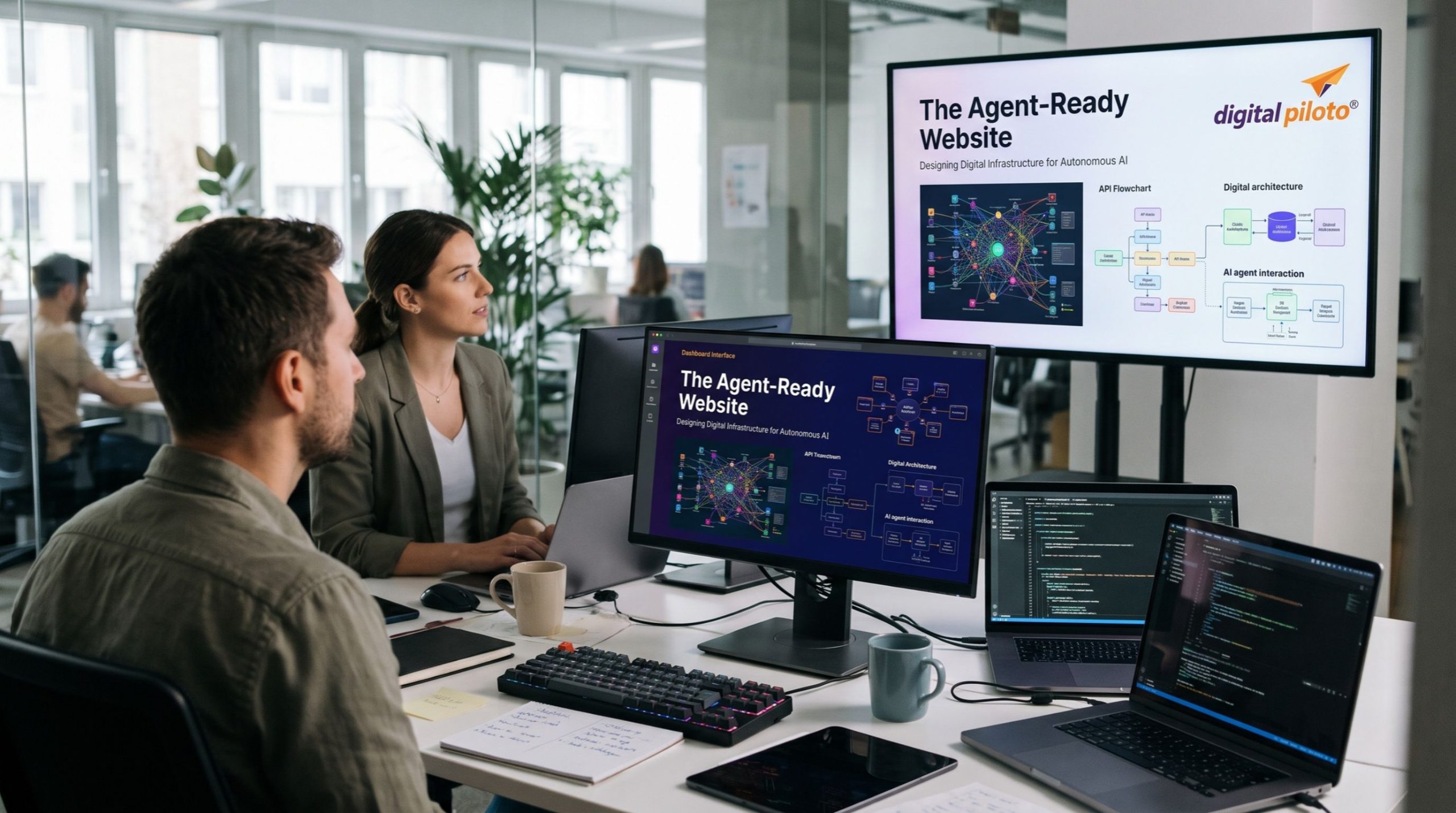
Imagine a customer asking an AI assistant to compare three hotels, check their room availability, review cancellation conditions and prepare a booking. The assistant may be able to locate the hotel websites, but that does not mean it can complete the task. One website may have unclear information, another may use an inaccessible booking interface, and a third may offer a supported integration that allows an authorized agent to retrieve availability directly. This is where the idea of an agent-ready website becomes important.
For organizations planning their digital future, the challenge extends beyond designing attractive pages. Businesses evaluating digital marketing service India options also need to consider whether their websites provide dependable information and support the digital interactions customers increasingly expect. AI-assisted discovery is already changing how people research businesses, while more advanced agent capabilities are creating possibilities for completing tasks on their behalf.
But does every business now need a special AI website, a dedicated agent server or a new technical protocol? No. An agent-ready architecture should begin with the needs of the business and its customers. Some websites primarily need better content access and technical clarity. Others may benefit from secure application interfaces and authorized transaction capabilities. Understanding the difference can prevent unnecessary investment.
What Is an Agent-Ready Website?
An agent-ready website is a digital platform designed to make relevant information accessible to compatible AI systems and, where appropriate, allow authorized agents to complete defined tasks reliably and securely. This can involve clear content, accessible interfaces, structured information, APIs, authentication and integration with supported tools.
The word “ready” needs context. A website that can be crawled for search discovery is not necessarily capable of supporting automated bookings, purchases or account updates. These activities require different technical mechanisms and levels of permission.
For example, a professional services website may be considered sufficiently prepared for its current needs if an AI-supported search system can find accurate service information and a potential customer can complete an enquiry. An ecommerce business supporting agent-based checkout may require considerably more infrastructure.
Agent readiness is therefore best understood as a capability matched to a specific use case, not a universal technical certificate.
Why Websites Are Evolving Beyond Human Browsing
Websites have traditionally been designed around people navigating pages, selecting menus, reading information and clicking buttons. Search engines added an important automated audience by crawling and indexing publicly accessible content.
AI assistants introduce another possibility: software that can perform selected activities on behalf of a person.
A customer may ask an assistant to research products, organize travel options, prepare an enquiry or compare service conditions. The assistant could gather information from supported sources and present an organized result without requiring the customer to visit every page manually.
Some agents can also interact with websites through browser interfaces or external tools, depending on their capabilities and the permissions available to them.
This creates a new design consideration. A website may need to communicate not only what the business offers but also which actions can be performed, what information is required and how those actions are safely completed.
The Difference Between a Search Crawler and an AI Agent
A search crawler generally discovers and retrieves information to support search-related processes. A user-directed AI agent may attempt to accomplish a specific task involving several steps.
OpenAI’s official crawler documentation identifies OAI-SearchBot as a crawler supporting discovery for ChatGPT Search.
This does not mean OAI-SearchBot is a booking agent or that allowing it access enables autonomous transactions.
A task-performing agent may use a browser or a connected tool with different access requirements. Businesses should evaluate these interactions separately instead of treating all automated traffic as one category.
What Makes a Website Technically Agent-Ready?
The foundation of an agent-ready website is not a collection of experimental files. It is a dependable digital environment in which information, navigation and supported capabilities behave consistently.
Four practical considerations can help businesses prioritize their investments: discoverability, interpretability, actionability and governance.
Discoverability: Can Relevant Systems Access the Information?
A website must make its important public information available through appropriate technical channels if that information is intended to be discovered.
This involves reviewing server responses, crawling permissions, navigation, canonical URLs and other technical factors that affect access and indexing.
For Google Search, the official AI Search optimization guide continues to recommend established SEO fundamentals.
Google also clarifies that a page must meet applicable technical eligibility requirements for inclusion in its AI Search experiences. Even then, crawling, indexing and display are not guaranteed.
Businesses should distinguish public discovery from restricted account access. Content containing private customer information should not become publicly accessible simply to accommodate automated systems.
Interpretability: Is the Information Clear and Accurate?
A website can be technically accessible while remaining difficult to understand.
A product page may describe several variations without clearly identifying their specifications. A service page may use broad promotional language without explaining what the service actually includes.
Clear headings, logical page structures, accurate product attributes and descriptive controls make information easier for people to interpret. They may also support compatible automated systems.
Structured data can help describe certain entities and properties where appropriate, but it must accurately represent the content and follow relevant platform policies.
Adding excessive markup does not automatically make a website agent-ready.
Actionability: Can an Authorized Task Be Completed?
Actionability is the ability to support a defined operation, such as retrieving availability, submitting a booking request or checking an order status.
These operations may be supported through an accessible browser interface, a structured API or another compatible integration.
An appointment-booking system, for example, needs to handle available dates, customer selections, required information, confirmation and potential errors.
A business should identify which tasks are worth automating before investing in technical interfaces.
For a company receiving occasional enquiries, improving its contact form may provide greater value than developing a dedicated agent tool. For a platform handling large numbers of routine reservations, a reliable integration could offer more significant operational benefits.
Governance: Are Actions Secure and Accountable?
The ability to perform an action introduces risks that do not exist when a website simply displays public information.
An AI system reading a publicly available service description usually requires fewer controls than a system changing account settings or completing a financial transaction.
Agent-related workflows need appropriate authentication, authorization, validation, logging and safeguards against unintended actions.
The level of protection should reflect the sensitivity and consequences of the task.
Why Traditional Technical SEO Remains Essential
Some discussions about agentic websites suggest that conventional SEO will soon become irrelevant because intelligent assistants can understand websites differently from search engines.
That conclusion is unsupported.
Google’s current guidance explicitly connects generative AI Search visibility with established technical SEO and useful content practices.
Businesses should continue reviewing indexability, crawling, rendering, internal linking, duplication, important page content and mobile usability where relevant.
These fundamentals serve human visitors and conventional search systems while providing a stable foundation for additional machine-assisted experiences.
JavaScript Websites Are Not Automatically Agent-Unfriendly
Many modern websites use JavaScript frameworks to create interactive interfaces and manage application state.
The use of JavaScript does not automatically make those websites incompatible with Google Search or AI agents.
However, implementation details matter. Important information may be difficult to retrieve when content depends on blocked resources, unreliable rendering or user interactions that cannot be completed by the relevant system.
The appropriate response is to test actual website behavior rather than impose universal server-side rendering or static-site generation requirements on every project.
Different agents also have different browser and tool capabilities, so compatibility should be verified with the intended environment.
How Structured Data Supports Machine Understanding
Structured data provides a standardized way to describe certain website entities and attributes.
For example, Organization markup can describe an applicable company’s identity, while Product markup can represent supported product attributes. Other structured data types may be appropriate for articles, breadcrumbs or local businesses.
These implementations should accurately reflect visible or otherwise legitimately represented information and comply with applicable documentation.
Google explicitly states that no special Schema.org markup is required for inclusion in its generative AI Search features.
This is an important distinction. Structured data may help eligible conventional search appearances, but it does not establish that an AI agent can perform a transaction or that a business will receive AI citations.
Machine-Readable Does Not Mean Machine-Only
A machine-readable website should still provide an excellent experience for people.
A product description that clearly explains materials, dimensions and intended use benefits customers as well as systems capable of interpreting those attributes.
An accessible booking form supports visitors using assistive technologies and may also be easier for certain browser-based agents to operate.
The goal is not to hide a second version of the business behind the visible interface. It is to maintain reliable information and interaction patterns suitable for legitimate users and supported systems.
APIs: The Foundation of Structured Agent Interactions
An application programming interface, or API, enables software applications to exchange information or request defined operations.
For an agentic workflow, an API may offer a more structured alternative to navigating a complex visual interface.
Consider a hotel with a supported availability API. An authorized system could request room availability for specified dates and receive an appropriately structured response.
This differs from an agent attempting to infer availability by repeatedly navigating calendar widgets or reading changing page layouts.
Structured interfaces can improve predictability for particular tasks, although they introduce their own security and maintenance responsibilities.
What Makes an API Suitable for Agents?
An API should provide clear operation definitions, expected inputs, predictable responses and meaningful error messages.
Relevant security controls may include authentication, scoped authorization, input validation, rate limiting and operational monitoring.
Sensitive operations should require stronger controls than public information retrieval.
For example, an API that retrieves public product specifications should not automatically provide permission to access customer payment details or modify orders.
Clear boundaries help protect customers and businesses while supporting permitted automation.
What Is the Model Context Protocol?
The Model Context Protocol (MCP) is an open protocol designed to connect AI applications with external tools, information and resources through a standardized interface.
In a compatible system, an MCP server can expose defined capabilities that an AI application may discover and use.
For example, a business system could expose a tool that retrieves the status of an authorized service request.
The AI application could call that tool according to its available permissions and integration configuration.
This can reduce the need to build completely different custom interfaces for every supported AI application.
However, implementing MCP is not a universal requirement for a business website or its appearance in Google Search.
When Does an MCP Integration Make Business Sense?
An MCP integration may be useful when an organization has defined workflows that AI applications need to access repeatedly.
Examples could include internal knowledge retrieval, authenticated account support or controlled business operations.
A company should evaluate whether the integration is supported by the intended applications, whether it offers measurable benefits and whether the security responsibilities can be managed.
For many informational websites, conventional web accessibility and appropriate existing APIs may be sufficient.
WebMCP and the Possibility of Browser-Native Agent Tools
WebMCP is an emerging approach intended to help websites expose structured functionality to compatible browser-based agents.
Instead of depending entirely on visual interpretation, an agent could potentially interact with explicitly described website capabilities.
W3C-related discussions in 2026 have continued exploring WebMCP, including questions about tool exposure, permission boundaries and agent integration.
For example, W3C discussion notes from 28 October 2026 cover ongoing work related to extending WebMCP functionality.
This is worth monitoring, but it should not be described as a universally deployed browser standard or a mandatory SEO requirement.
Why Emerging Standards Need Careful Evaluation
New protocols can provide useful architectural options without becoming relevant to every business immediately.
Adopting a technology before its ecosystem, security behavior and practical benefits are understood may introduce costs without solving a real customer problem.
Businesses should distinguish between experimental implementations, officially supported products and capabilities available across the applications their customers actually use.
Do Websites Need llms.txt or Special AI Files?
Some AI optimization guides recommend creating special machine-readable files, including llms.txt, to make websites easier for AI systems to understand.
These approaches should be evaluated carefully rather than treated as universal requirements.
Google’s official AI Search guidance states that websites do not need llms.txt, special AI text files or AI-specific markup to appear in Google Search, including its generative AI features.
Other applications may choose to use particular discovery conventions, but their behavior must be verified independently.
A business should not spend heavily implementing optional files without identifying which supported systems will actually use them and what measurable benefit they provide.
How Agentic Commerce Could Change Ecommerce Websites
Ecommerce provides one of the clearest potential use cases for agentic website infrastructure.
An AI assistant may help customers identify products, compare specifications and complete selected purchasing steps through supported integrations.
This could reduce manual effort during routine shopping experiences, but it also creates new requirements for accurate pricing, inventory, permissions and order handling.
Google’s Universal Commerce Protocol
Google provides documentation for the Universal Commerce Protocol (UCP), a standard intended to support compatible agentic commerce experiences.
Its developer guidance covers merchant integration, checkout-related workflows and additional commerce capabilities.
These are meaningful developments, but availability depends on the relevant platform integration and merchant requirements.
A merchant should not assume that publishing an ordinary product page automatically enables an AI assistant to complete checkout.
Product Information Must Remain Accurate
Agent-assisted shopping depends on reliable commercial information.
A product’s price, availability, variations, delivery terms and return conditions should be maintained accurately within the relevant systems.
Inconsistent information creates a risk that the customer will receive an unsuitable recommendation or encounter a different offer during checkout.
Product feeds, structured content and supported commerce integrations can be evaluated according to the merchant’s actual requirements.
Security Must Come Before Autonomous Transactions
Autonomous AI is most useful when its permissions are matched to the consequences of the task.
An agent comparing public product details is different from an agent initiating a payment or changing a customer account.
Businesses need to decide what actions may be performed automatically, which require authentication and which require explicit user approval.
Authentication and Authorization Are Not the Same
Authentication helps establish who or what is making a request.
Authorization determines what that identity is permitted to do.
A verified agent identity should not receive unrestricted access merely because it is recognized.
A task involving customer data may require tightly scoped permissions and appropriate user consent or another applicable authorization basis.
Protect Against Prompt Injection and Untrusted Instructions
AI agents may encounter text on web pages, in files or in external system responses.
Some of that content may contain malicious instructions intended to redirect an agent away from the user’s legitimate task.
This creates a prompt-injection risk, particularly when an agent can access sensitive tools or perform consequential actions.
The security design should treat retrieved content as untrusted data, preserve authorization boundaries and validate sensitive operations independently of generated instructions.
Businesses should not rely solely on a model’s willingness to follow instructions as a security control.
Human Approval for High-Impact Actions
A sensible system may allow an agent to collect information or prepare an action while reserving final approval for a person.
For example, an agent could prepare a purchase summary and ask the customer to approve the order before payment.
Human confirmation may also be appropriate for cancellations, account changes, financial commitments and other significant operations.
The approval process should be clear enough that users understand what will happen before the action is executed.
Agent Readiness Is Different for Different Industries
Not every website needs the same level of agent infrastructure.
The requirements of an informational publisher are different from those of an ecommerce marketplace, booking platform or authenticated financial service.
Professional Service Websites
A consultancy website may benefit from clear service descriptions, accessible contact methods, verified team information and useful educational resources.
An agent could help a prospective customer research the company and prepare questions before making an enquiry.
Advanced transaction protocols may provide little additional value unless the business supports repeatable automated services or bookings.
Ecommerce Businesses
An online retailer may need reliable product feeds, accurate inventory, appropriate structured data and secure checkout integrations.
Agentic commerce becomes relevant when supported customer workflows can genuinely benefit from machine-assisted product selection or purchasing.
Travel and Hospitality
Hotels and travel providers may find value in authorized availability retrieval, reservations and booking-related customer support.
These workflows require accurate commercial terms and careful handling of cancellations, confirmations and customer information.
Healthcare and Other Sensitive Services
Organizations dealing with sensitive personal information require additional care.
An agent may help locate public information about a service, but accessing records or performing account-specific actions can introduce significant privacy, consent and security requirements.
The available capabilities should be evaluated according to the applicable laws, professional obligations and supported technical systems.
How to Audit an Existing Website for Agent Readiness
An agent-readiness audit should begin with the actual tasks customers need to complete.
It should then evaluate whether the website supports those tasks reliably and whether additional integration is justified.
Stage 1: Review Public Information
Confirm that the most important pages accurately explain the organization, its products, services, conditions and available customer actions.
Look for outdated facts, inaccessible information and unnecessary ambiguity.
Stage 2: Test Technical Accessibility
Review crawling permissions, HTTP responses, navigation, important JavaScript-dependent content and relevant indexing settings.
Check actual rendering and accessibility instead of assuming that a page is readable because it looks correct in a normal browser session.
Stage 3: Identify Supported Interactions
List the activities users may want an assistant to perform, such as retrieving product specifications, checking availability or preparing enquiries.
Distinguish tasks that can already be completed through existing interfaces from those requiring new integrations.
Stage 4: Evaluate Security and Permissions
For each proposed action, determine the required identity verification, permissions, validation and approval process.
Sensitive operations should receive stronger safeguards and clear failure-handling procedures.
Stage 5: Test With Realistic Scenarios
Create representative tasks and evaluate whether supported systems can complete them correctly.
Measure not only successful completion but also errors, unexpected behavior, customer confusion and security controls.
A successful demonstration on one agent platform should not be treated as universal compatibility.
A 90-Day Agent-Ready Website Roadmap
For many businesses, a phased implementation is more practical than attempting to redesign the entire website around autonomous AI immediately.
The following roadmap is a Digital Piloto editorial recommendation and should be adapted to each organization’s technical maturity.
- Days 1–30: Establish the foundation. Audit business information, technical SEO, public content, important forms and relevant website accessibility issues. Identify realistic customer tasks.
- Days 31–60: Improve the experience. Correct information gaps, simplify workflows, review structured data where relevant and assess existing APIs. Introduce controlled technical changes that serve confirmed use cases.
- Days 61–90: Test and prioritize integrations. Evaluate compatible agent workflows, permission boundaries, logging, task success and commercial usefulness. Expand only when the evidence supports further investment.
The objective is not to achieve a perfect score on every agent-readiness checklist.
It is to create a reliable platform that supports meaningful customer interactions and can evolve as compatible technologies mature.
How to Measure the Value of an Agent-Ready Website
Agent readiness should not be measured exclusively through the number of protocols implemented or the presence of a particular file.
A business needs to determine whether the changes improve its website’s usefulness, operational reliability and commercial outcomes.
Technical Measurements
Review relevant crawlability, rendering, interface accessibility, API response reliability, error handling and supported agent task completion.
Measure these using repeatable tests and clearly defined environments.
Customer Experience Measurements
Assess whether users can find accurate information, complete the intended action and understand the outcome.
Task failures, repeated requests and confusing confirmations may indicate problems that technical implementation statistics overlook.
Commercial Measurements
Where suitable attribution is available, assess qualified enquiries, completed bookings, purchases, support efficiency or other business-relevant outcomes.
An integration that increases technical complexity without improving customer experience may not justify continued investment.
Security Measurements
Review unauthorized requests, validation errors, permission failures and any actions that required reversal.
Strong governance is part of successful agent implementation, not an optional consideration after launch.
Common Mistakes in Agent-Ready Website Development
One mistake is assuming that adding llms.txt immediately makes a site more visible in Google AI Overviews.
Another is installing an MCP server without defining which legitimate customer task requires it.
Some businesses expose sensitive functions too broadly in an attempt to make automation easier.
Others redesign their entire website for machines while making the human experience worse.
A further mistake is treating the results of a third-party readiness scanner as a guaranteed indicator of AI rankings, citations or revenue.
The better approach is to validate real problems, choose appropriate technical solutions and measure the results.
How Agent-Ready Infrastructure Connects With AI Search and SEO
AI search discovery and autonomous agent interaction overlap in some technical areas, but they should be managed as separate capabilities.
Search visibility depends on the relevant platform’s indexing, retrieval and content-selection processes.
Agentic interaction depends on whether a compatible system can perform a supported task through an available interface.
A website can perform well in search while offering no agent-specific transaction capabilities.
Conversely, a business may maintain an excellent authenticated API without appearing prominently in public search results.
Why Business Identity and AI Discovery Matter
Organizations exploring a ChatGPT business hub should distinguish business information accuracy from autonomous agent compatibility.
Reliable business names, service details and public contact information can help customers and relevant discovery systems understand the organization.
However, no universal business listing or schema property guarantees ChatGPT recommendations, and a public business profile does not automatically enable authorized account transactions.
The appropriate strategy depends on whether the business is trying to improve discoverability, customer understanding or task completion.
The Future of Agent-Ready Websites
Over the coming years, it is plausible that more business systems will expose well-defined actions to compatible AI applications.
Customers may increasingly ask assistants to organize research, prepare transactions or coordinate selected services.
Developers may also gain more mature standards for advertising capabilities, authenticating agents and connecting tools with user permission.
But adoption will not occur uniformly across every industry.
Some businesses will benefit from sophisticated agent integrations. Others may continue to generate excellent results through accurate information, accessible websites and straightforward customer service.
The most important principle is to invest in capabilities that solve real problems rather than attempting to predict one universal future web architecture.
Digital Piloto’s Strategic Perspective
For Digital Piloto, the transition toward agent-ready websites should be understood as an extension of good digital infrastructure, not a replacement for established website fundamentals.
Useful content, technical reliability, accurate business information and strong conversion journeys remain valuable regardless of how AI assistants evolve.
Organizations investigating an SEO optimization company India should evaluate whether the provider can distinguish practical SEO improvements from experimental agent-specific features.
A useful modernization strategy should connect audience needs, website accessibility, business objectives and appropriately secured technology.
The most advanced implementation is not necessarily the best one. The best solution is the one that reliably supports the organization’s customers and creates measurable value.
Frequently Asked Questions
What is an agent-ready website?
An agent-ready website provides information and supported interfaces that compatible AI agents can use reliably. Depending on its business purpose, this may involve accessible content, structured information, APIs, authentication and authorized task workflows. Not every website requires advanced agent-specific infrastructure.
How is an agent-ready website different from an SEO-friendly website?
An SEO-friendly website supports discovery and indexing by relevant search systems. An agent-ready website may additionally support AI agents performing defined tasks. The two approaches share useful technical foundations, but task execution introduces requirements involving permissions, integration and security.
Does Google require websites to support MCP or WebMCP?
No. Google’s official AI Search guidance does not require MCP, WebMCP or other agent-specific protocols for inclusion in AI Overviews or AI Mode. Those technologies address particular integration scenarios rather than universal Google Search requirements.
Is llms.txt necessary for AI search visibility?
Google states that llms.txt and special AI text files are not necessary for visibility in Google Search, including its generative AI features. Other platforms may have different documented capabilities, which should be assessed individually.
Can an AI agent complete purchases on any ecommerce website?
No. Agent-assisted purchasing depends on supported tools, merchant integrations, available product information, transaction permissions and compatible checkout systems. An ordinary ecommerce page does not automatically support autonomous purchasing.
What role does MCP play in agent-ready infrastructure?
The Model Context Protocol provides a standardized way for compatible AI applications to access connected tools and resources. It can support defined business workflows, but its implementation should be based on real integration needs and appropriate security controls.
How can a small business prepare its website for AI agents?
A small business can begin by improving service information, website accessibility, technical reliability, contact methods and relevant customer workflows. It can then evaluate agent integrations where there is a clear business benefit. Advanced protocols are not automatically necessary.
How should agent readiness be measured?
Businesses can measure information accuracy, technical accessibility, task success, error handling, security behavior and relevant commercial outcomes. Third-party readiness scores may offer diagnostic assistance, but they do not guarantee AI citations, higher rankings or increased revenue.
Final Thoughts: Design for People, Prepare for Agents
AI agents are introducing new possibilities for how customers interact with digital businesses.
Websites may increasingly support software-assisted research, structured information retrieval and authorized task completion alongside conventional human browsing.
But the transition should be built on dependable foundations: accurate content, accessible interfaces, appropriate technical architecture and strong security.
Businesses should avoid investing in experimental technologies without identifying the customer problem they solve.
The future of an agent-ready website is not about removing humans from the experience. It is about creating digital infrastructure that helps people and authorized intelligent systems interact with businesses more effectively.
Digital Piloto can help organizations evaluate their technical SEO, website architecture, AI search readiness and opportunities for practical digital modernization through an evidence-based strategy.
Content Development Credits
Conceptualized by Amlan Maiti, with AI-assisted research and drafting. SEO, GEO and editorial development credited to the Digital Piloto team.