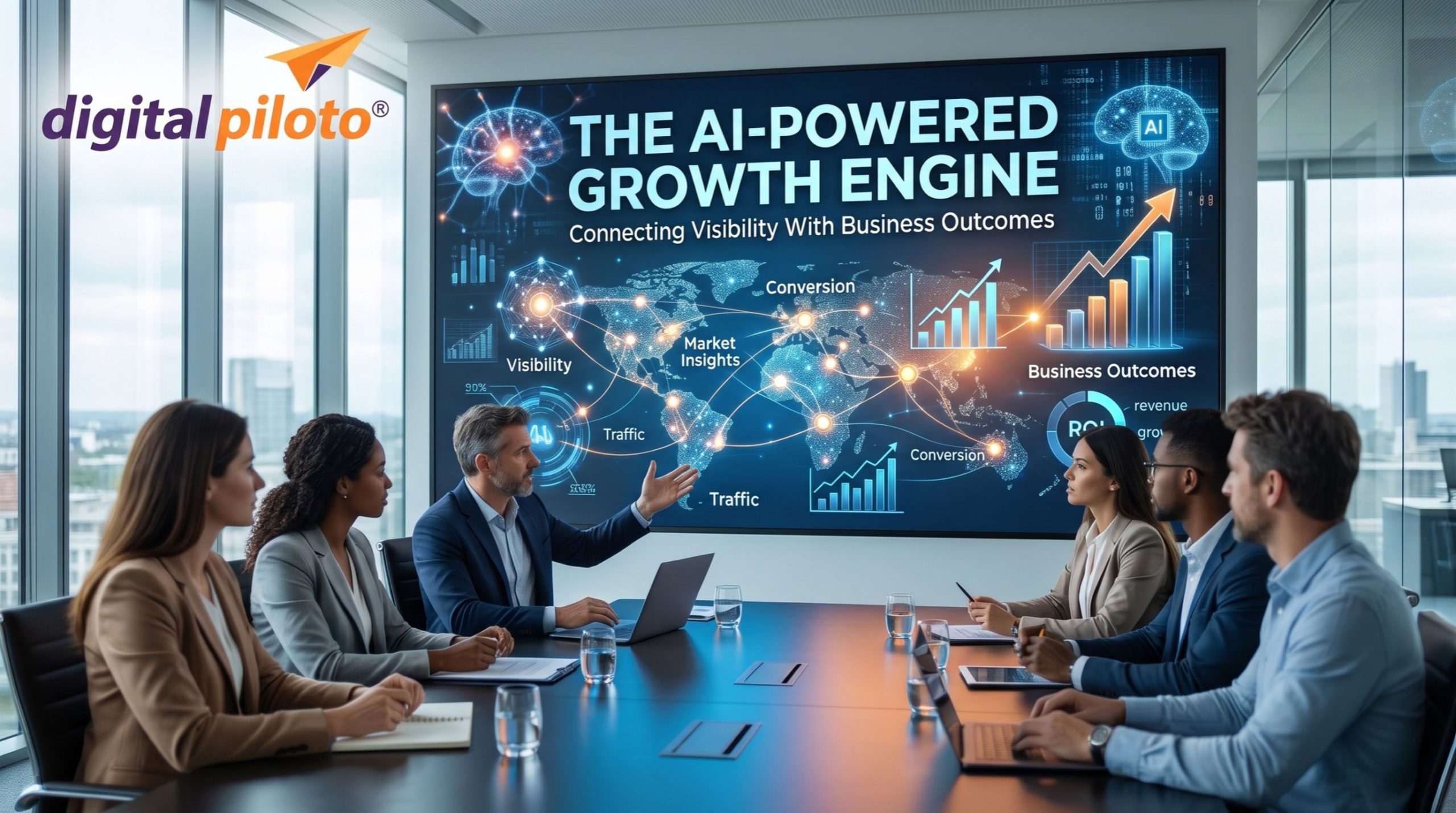
A business can appear in search results, attract website visitors, and collect thousands of social media impressions without seeing meaningful revenue growth. Visibility is valuable, but it is only the beginning. The real opportunity lies in connecting AI-powered discovery with qualified leads, stronger customer relationships, and measurable business outcomes.
For a modern digital marketing agency India, this means looking beyond rankings and traffic reports. Marketing must connect brand discovery, customer intent, conversion experiences, and revenue into one coordinated growth system. AI can help make those connections more intelligent, provided businesses give it the right strategy and reliable data.
Why Visibility Alone Is No Longer Enough
Traditional digital marketing often treats visibility as a major indicator of success. A page ranks on Google, a campaign generates clicks, or a social post receives attention. These are useful signals, but they do not necessarily tell us whether the business is attracting the right audience.
Consider a B2B software company receiving 10,000 monthly visitors. That number looks impressive. Yet, if most visitors are students researching a general topic rather than decision-makers evaluating software, the commercial value may be limited.
Now imagine a competitor attracting only 2,000 visitors but generating 40 qualified enquiries from companies that match its ideal customer profile. The smaller audience may be producing a much stronger business result.
This distinction becomes even more important as AI-powered search and conversational discovery change how customers find information. A potential buyer might receive a recommendation from an AI assistant, compare providers through a generated summary, and visit only one or two websites before making contact.
Businesses therefore need to measure not only whether they are visible, but whether that visibility influences meaningful decisions.
What Is an AI-Powered Growth Engine?
An AI-powered growth engine is a connected marketing and business system that uses artificial intelligence, customer data, automation, and performance measurement to improve the journey from discovery to revenue.
It is not simply a chatbot added to a website or an automated tool that publishes social media updates. Those may be useful components, but a growth engine connects several activities that traditionally operate in separate departments.
Think of it as a relay team. Search visibility introduces the business. Content helps customers understand its expertise. Personalization makes information more relevant. Conversion systems capture genuine interest. Sales teams turn qualified opportunities into customers. Analytics then reveal which activities deserve further investment.
AI can support each stage by identifying patterns, reducing repetitive work, improving recommendations, and helping teams make better-informed decisions.
The Four Stages That Connect Visibility With Revenue
1. Discovery: Getting found in the right places
Customers may discover a business through traditional search engines, AI-generated answers, social platforms, industry publications, online communities, and recommendations. A modern visibility strategy should account for this wider environment.
For example, a company offering enterprise cybersecurity services should not rely entirely on ranking for a single commercial keyword. It should also publish useful explanations of security risks, practical implementation guidance, service comparisons, and credible evidence of expertise.
This broader approach supports organic search visibility and gives customers more ways to understand what the company actually does.
2. Engagement: Turning attention into understanding
Once someone discovers a brand, the next challenge is helping them evaluate it. AI can assist by recommending relevant resources, organizing frequently asked questions, and supporting more personalized content experiences.
However, relevance matters more than novelty. A first-time visitor researching an unfamiliar service probably needs a clear explanation, not an aggressive sales offer. A returning visitor comparing packages may need pricing details or a consultation option.
The experience should respond to the customer’s situation rather than pushing everyone through the same marketing sequence.
3. Conversion: Making the next step easier
Interest does not automatically become a sale. Confusing forms, unclear pricing, slow websites, and weak follow-up processes can interrupt an otherwise promising customer journey.
AI-supported lead scoring can help identify enquiries that deserve faster attention. Conversational interfaces can answer routine questions, while marketing automation can deliver relevant information after a prospect requests it.
Human sales teams remain essential, especially when purchases involve technical evaluation, negotiation, or long-term commitments. The purpose of automation is to help people respond more effectively, not remove meaningful human interaction.
4. Retention: Turning customers into long-term value
Growth does not end when someone makes a purchase. Existing customers may need onboarding, training, technical assistance, additional services, or renewal reminders.
AI can help identify common support issues, detect patterns in customer feedback, and suggest useful follow-up communication. When these insights reach the right teams, businesses can improve customer experience and identify opportunities for responsible cross-selling.
Retention is particularly important in subscription businesses, professional services, and B2B markets where customer relationships can continue for years.
How AI Connects Marketing Data With Business Decisions
One of the biggest barriers to effective growth is fragmented information. Website analytics may sit in one platform, advertising data in another, and customer information inside a CRM. Sales teams may maintain additional records that marketing never sees.
AI becomes more useful when these systems can exchange appropriate information and provide a clearer view of the customer journey.
For example, a business might discover that visitors who read a particular technical guide are more likely to request a product demonstration. That insight could influence content placement, lead nurturing, and advertising audiences.
Similarly, sales data may reveal that leads from one campaign generate more revenue over time, even if that campaign produces fewer enquiries. Marketing teams can use this information to reconsider budget allocation.
Research from McKinsey’s State of AI report has documented the expanding use of AI across business functions. The commercial lesson is not that adopting AI automatically creates growth. Rather, organizations need to connect AI applications to specific workflows and outcomes if they want measurable value.
Building a Connected AI Marketing Strategy
A practical growth engine needs more than a collection of disconnected tools. Businesses should build a system in which content, technology, customer experience, and measurement support one another.
Several foundations deserve attention:
- Define the right audience: identify ideal customer profiles, important customer problems, buying motivations, and the questions people ask before purchasing.
- Build useful digital assets: develop authoritative service pages, educational content, comparison resources, and clear conversion paths.
- Connect marketing and sales data: use appropriate CRM and analytics integrations to understand which interactions produce qualified opportunities.
- Automate with purpose: apply AI to repetitive tasks, lead prioritization, content recommendations, and reporting where it can improve efficiency.
- Review performance regularly: compare campaign activity with lead quality, conversion rates, revenue contribution, and customer retention.
For organizations planning broader technology improvements, business digital transformation services can help connect digital marketing with website systems, customer relationship management, automation, and business operations. This integration matters because a marketing campaign cannot deliver its full potential if the systems handling enquiries and customer relationships are disconnected.
Measuring What Actually Drives Business Growth
A growth engine needs a measurement framework that distinguishes activity from impact. Page views, impressions, and clicks explain what happened at the top of the funnel. They do not provide the complete commercial picture.
Businesses should consider a combination of indicators:
- Discovery metrics: organic visibility, relevant search impressions, branded searches, referral sources, and AI-platform mentions.
- Engagement metrics: meaningful page interactions, content-assisted enquiries, return visits, and resource downloads.
- Conversion metrics: qualified lead volume, lead-to-customer rate, cost per acquisition, and sales-cycle duration.
- Revenue metrics: customer lifetime value, average deal size, recurring revenue, and marketing-influenced revenue.
Customer acquisition cost (CAC) deserves particular attention. A business should compare the cost of acquiring customers with the value those customers generate over an appropriate period. A campaign that produces inexpensive leads may still be inefficient if those leads rarely become paying customers.
Attribution also needs careful handling. AI discovery may influence a customer’s decision without appearing as the final recorded traffic source. Combining analytics, CRM records, customer surveys, and repeatable AI visibility checks can provide a more realistic picture than relying on last-click reporting alone.
The Role of SEO in an AI-Powered Growth Engine
Search engine optimization remains an important part of this system, but its purpose should extend beyond securing positions for individual keywords. Strong SEO helps businesses make their expertise discoverable, organize information clearly, and attract people with relevant needs.
Modern search engine optimization services India can contribute through technical website improvements, search-intent research, content quality, internal linking, and entity consistency.
AI-focused discovery adds another consideration: information should be easy to understand and verify. Clear service descriptions, accurate business details, useful definitions, credible references, and structured data can support better interpretation across digital systems.
Google’s people-first content guidance reinforces the importance of creating genuinely useful information for visitors. Businesses should treat this as a foundation rather than trying to manufacture content solely to attract algorithmic attention.
Common Mistakes That Weaken AI-Driven Growth
AI can make marketing operations faster, but speed alone does not create a better strategy. Some businesses adopt several new tools without deciding what problem they are supposed to solve. Others generate large volumes of content but neglect accuracy, differentiation, and conversion design.
Watch out for these mistakes:
- Chasing visibility without commercial intent: attracting an audience that has little connection to the business’s actual customers.
- Automating poor processes: using AI to accelerate confusing lead management or irrelevant communication.
- Ignoring data quality: expecting accurate recommendations from incomplete, outdated, or inconsistent information.
- Overlooking human review: publishing incorrect claims or allowing automated interactions to frustrate customers.
- Measuring vanity metrics: celebrating traffic growth without checking lead quality, sales, or retention.
Responsible implementation also requires attention to privacy, access controls, data security, and applicable regulations. Businesses should collect and process only the information they need and explain relevant data practices transparently.
What the Future of AI-Powered Business Growth Looks Like
The next stage of digital marketing will likely involve closer coordination between discovery platforms, content systems, customer data, and intelligent automation. AI agents may help customers research options, while business systems respond with relevant product information, availability, or support resources.
For marketers, this means moving from isolated campaigns towards connected customer experiences. A successful strategy will not simply ask how many people saw an advertisement. It will ask whether the right people discovered the brand, understood its value, took a meaningful action, and remained satisfied after purchasing.
Companies that build this capability gradually will have an advantage over those that adopt tools without a clear operating model. The technology will continue to change, but the underlying business objective remains familiar: understand customers better and make it easier for them to choose the right solution.
FAQs
What is an AI-powered growth engine?
It is a connected business and marketing system that uses AI, customer data, automation, and analytics to improve discovery, engagement, lead generation, conversion, and retention.
How does AI visibility contribute to business outcomes?
AI visibility can help a brand appear in relevant recommendations and information responses. This may influence awareness and consideration, although businesses should measure qualified enquiries and revenue rather than assuming every mention creates a sale.
Which metrics should businesses track?
Businesses should monitor relevant visibility, qualified leads, conversion rates, customer acquisition cost, customer lifetime value, sales-cycle duration, and revenue contribution. The right combination depends on the business model.
Can small businesses build an AI-powered growth engine?
Yes. Small businesses can begin with useful website content, basic analytics, a well-maintained CRM, simple automation, and clear conversion goals. They can introduce more advanced AI capabilities as their needs and resources grow.
Final Thoughts
The real value of AI in marketing is not measured by how many tools a business adopts or how often its name appears online. It is measured by whether discovery leads to meaningful customer relationships and sustainable revenue. By connecting visibility, useful content, customer data, conversion, and retention, businesses can turn AI from an interesting technology into a practical engine for growth.
Blog Development Credits
The article concept was developed with Amlan Maiti; AI-assisted research and drafting were followed by final editorial refinement and SEO enhancements from Digital Piloto Private Limited.