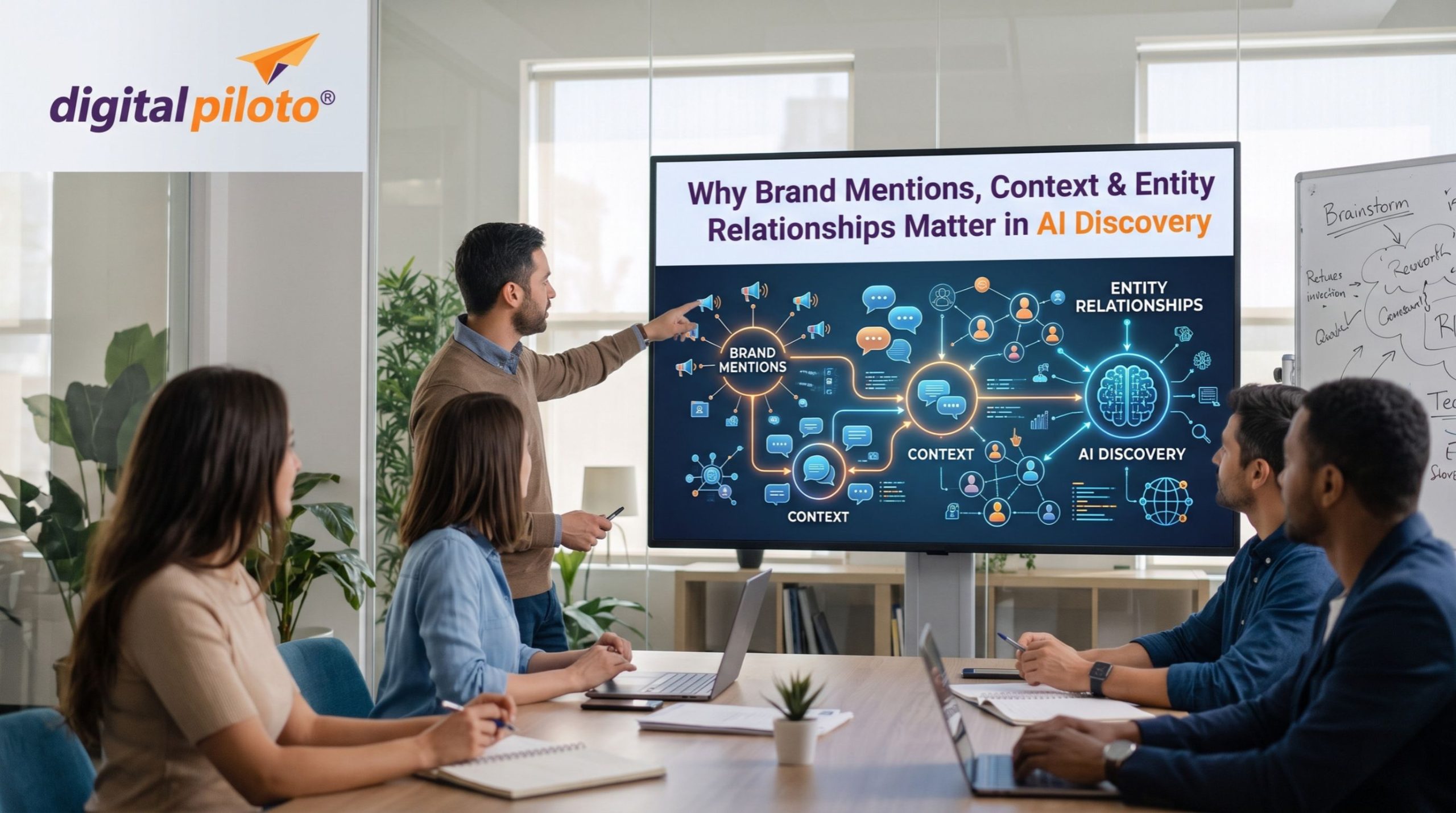
A brand can publish hundreds of articles, run campaigns across multiple platforms, and rank for valuable keywords, yet still remain difficult for AI systems to understand. Why? Because visibility is not just about being mentioned. It is also about the meaning surrounding those mentions and the relationships connecting a brand to people, services, industries, and ideas.
For a modern digital marketing agency India, this creates a broader challenge than traditional search optimization. Businesses need to build a recognizable digital identity that search engines and AI-powered discovery platforms can interpret consistently. Brand mentions, contextual relevance, and entity relationships all contribute to that larger picture.
AI Discovery Is About Meaning, Not Just Keywords
Traditional keyword optimization often starts with a straightforward question: which words do people type into search engines? That question still matters, but modern discovery systems need to understand more than matching phrases.
Consider someone searching for a company called Sunrise Technologies. Is it a software developer, a solar equipment manufacturer, or a local electronics retailer? The name alone does not provide enough information. Search systems need surrounding clues to identify the correct organization.
This is the difference between recognizing a string of text and understanding an entity. An entity is a distinct real-world thing—a company, person, product, location, organization, or concept—that can be identified through its attributes and connections.
Google introduced its Knowledge Graph in 2012 with the idea of helping Search understand real-world things and their relationships rather than treating every query as a collection of words. Its original announcement described a system containing hundreds of millions of entities and billions of associated facts. The scale has since expanded substantially, with Google’s later explanation discussing billions of entities and hundreds of billions of facts.
For businesses, the practical lesson is simple: make it easier for digital systems to understand exactly who you are, what you do, and why your organization is relevant to a particular subject.
Why Brand Mentions Matter in AI Discovery
A brand mention occurs whenever an organization is referenced online, whether or not that reference includes a clickable link. It might appear in an industry article, a business directory, a podcast transcript, a product comparison, a customer review, or a professional discussion.
These references can help establish a brand’s presence beyond its own website. They also create opportunities for different sources to describe the organization in relation to particular products, services, locations, and areas of expertise.
Imagine a company that offers ecommerce development. Its website describes its services, but independent articles also discuss its Shopify projects, business directories identify its location, and customer reviews mention its development support. Taken together, these references create a more informative public footprint than a single company profile could provide.
However, not every mention is equally useful. A brand name appearing repeatedly in unrelated content may create little meaningful understanding. A smaller number of accurate, relevant references can be more valuable from a credibility and clarity perspective.
Where meaningful brand mentions can come from
- Industry publications: Articles that discuss a company’s expertise, research, products, or contribution to its sector.
- Relevant business directories: Consistent company information in trustworthy listings and professional databases.
- Customer reviews: Genuine feedback that describes actual services, experiences, and product strengths.
- Expert contributions: Interviews, podcasts, webinars, and commentary that connect a brand with a recognizable subject area.
- Partner references: Supplier, technology, client, and industry association pages that accurately describe business relationships.
The goal should not be to manufacture mentions. It should be to create worthwhile reasons for other people and organizations to discuss the brand.
Context Gives a Brand Mention Its Meaning
A mention without context can be surprisingly ambiguous. Suppose an article simply says, “Orion works with businesses across India.” That sentence tells us very little. Is Orion a logistics company, an accounting firm, or a digital agency?
Now consider a more descriptive reference: “Orion develops ecommerce websites and integrates inventory systems for retail businesses.” Suddenly, the organization has a clearer professional identity.
Context helps connect a brand with the subjects it genuinely serves. It answers questions such as:
- Which industry does the organization operate in?
- What products or services does it provide?
- Which customer groups does it serve?
- What locations or markets are relevant to its operations?
- What expertise, technology, or business problems are associated with it?
This is particularly important in AI-powered discovery, where a user may ask a conversational question rather than enter a short keyword. Someone might ask, “Which companies help manufacturers modernize their ecommerce operations?” A brand needs a clear, credible connection to that subject to be a relevant candidate for discovery.
Google’s current guidance for AI features in Search emphasizes helpful, reliable, people-first content and established SEO fundamentals. It does not describe a special formula in which brand mentions guarantee inclusion. Its AI features documentation makes clear that eligibility and visibility are not guaranteed, even when technical requirements are met.
Entity Relationships Build a Stronger Digital Identity
Think of a brand as one point in a large network. It may connect to a founder, a product range, a service category, a geographical location, an industry, and a group of customers. These connections help explain what the brand represents.
For example, a business offering cloud-based accounting software may have relationships with:
- People: Its founder, leadership team, product specialists, and recognized experts.
- Products: Accounting software, invoicing tools, payroll modules, and reporting features.
- Industries: Small businesses, professional services, retail, and finance.
- Technologies: Cloud computing, automation, payment integrations, and data analytics.
- Locations: Its registered office, operating markets, and supported service regions.
These relationships should be genuine and clearly explained. A company should not associate itself with every popular technology or industry simply to appear relevant. Artificial connections can confuse users and weaken trust.
Why relationships are more useful than isolated claims
Imagine reading two descriptions of a marketing consultancy. The first says it is an innovative, customer-focused, full-service agency. The second explains that it provides search optimization, paid advertising, conversion analysis, and marketing automation for growing businesses.
The second description offers more useful information. It connects the organization to identifiable services and customer needs. It gives both people and machines a clearer basis for understanding the company’s role.
This is the essence of entity-based SEO: organizing information so that a business, its offerings, and its areas of expertise are consistently represented across digital properties.
How Websites Can Communicate Entity Information Clearly
A company’s website should act as the central reference point for its digital identity. External mentions may introduce the brand, but its own website should explain the facts accurately and comprehensively.
Start with the fundamentals. The About page should identify the organization and explain its purpose. Service pages should describe individual offerings rather than grouping everything into vague marketing language. Leadership profiles should use consistent names and professional details. Contact pages should present accurate business information.
Structured data can provide another layer of clarity. Google’s documentation explains that Organization structured data can help Search understand administrative details and distinguish one organization from another. Relevant properties may include the organization’s name, URL, logo, address, and official social profiles.
Structured data is not a shortcut to AI recommendations, nor does it guarantee a Knowledge Panel. It is a way to describe information in a standardized format. The markup must also reflect what visitors can actually see on the website.
Building an Entity Strategy Across Digital Channels
Entity clarity should not be treated as a one-page SEO task. It requires coordination across content, public relations, social media, business listings, and customer communication.
Businesses investing in business digital transformation services can approach this as part of a wider effort to organize digital information and strengthen their online presence. The aim is to ensure that important company facts remain consistent as the organization expands into new channels, products, and markets.
A practical approach includes the following steps:
- Define the core brand entity: Establish the official business name, website, location, primary category, and main service descriptions.
- Map related entities: Identify genuine connections with founders, products, technologies, industries, customers, and operating locations.
- Strengthen authoritative website pages: Create useful service descriptions, expert profiles, case studies, and company information.
- Earn relevant external references: Contribute original insights, participate in industry discussions, and build relationships with credible publications and partners.
- Maintain consistency: Review business listings, social profiles, company descriptions, and structured data whenever important details change.
Consistency does not mean repeating the same paragraph everywhere. Different platforms can describe a company in different ways, provided the underlying facts remain accurate.
Measuring Whether Your Brand Is Becoming More Understandable
Entity development is not always reflected in one convenient ranking report. Businesses should monitor a combination of visibility, accuracy, and reputation signals.
Useful indicators include branded search demand, relevant referral traffic, quality industry mentions, consistency of business information, and the accuracy of brand descriptions across public platforms. Teams can also test a selection of relevant questions across AI discovery tools and record whether the brand appears, how it is described, and which sources are referenced.
These checks are directional, not definitive. AI responses can vary depending on the question, platform, location, and available sources. A brand appearing in one answer does not prove that it has established permanent authority.
Similarly, an SEO optimization company India should evaluate entity development alongside technical SEO, content quality, search visibility, and reputation—not as an isolated promise of AI rankings.
Common Mistakes That Weaken Brand Entity Signals
Some businesses try to accelerate recognition by publishing large volumes of repetitive content or distributing identical company descriptions across unrelated websites. This may increase the number of references, but it does not necessarily improve understanding.
Other common mistakes include:
- Using inconsistent company names, addresses, or service descriptions across platforms.
- Publishing vague content that lists services without explaining their practical value.
- Creating artificial relationships with industries, experts, or organizations.
- Ignoring outdated profiles and inaccurate third-party business information.
- Adding structured data that does not match the visible content.
The better approach is steady, evidence-based brand building. Publish useful material, explain expertise clearly, earn authentic references, and correct factual inconsistencies when they appear.
Frequently Asked Questions
1. What are brand mentions in AI discovery?
Brand mentions are online references to a company, product, or organization. They may appear with or without links. Relevant mentions can help establish a brand’s public presence and connect it with specific services, industries, and topics.
2. Are brand mentions more important than backlinks?
They serve different purposes. Backlinks can help users and search engines discover connected pages, while unlinked mentions can still provide public context about a brand. Neither should be treated as a guaranteed ranking or AI citation factor.
3. What is an entity relationship in SEO?
An entity relationship describes a meaningful connection between identifiable things. For example, a company may be connected to its founder, products, service categories, technologies, customers, and operating locations. Clear relationships help explain the organization’s identity.
4. Does structured data guarantee AI visibility?
No. Structured data helps describe information in a standardized format, but it does not guarantee rankings, Knowledge Panels, or inclusion in AI-generated answers. Accurate content, technical accessibility, relevance, and broader credibility remain important.
Final Thoughts: Build Recognition Through Meaning
AI discovery is making digital identity more important than simply occupying space in search results. Brands need to be recognizable, accurately described, and meaningfully connected to the subjects they serve. That takes more than repeated mentions or clever markup. It requires consistent information, useful expertise, genuine relationships, and a reputation supported by credible sources. In the long run, a brand that is easy to understand has a stronger foundation for being discovered.
Blog Development Credits
Conceived by Amlan Maiti, this article combines AI-assisted research and editorial development, with final content refinement and SEO enhancements by Digital Piloto Private Limited.