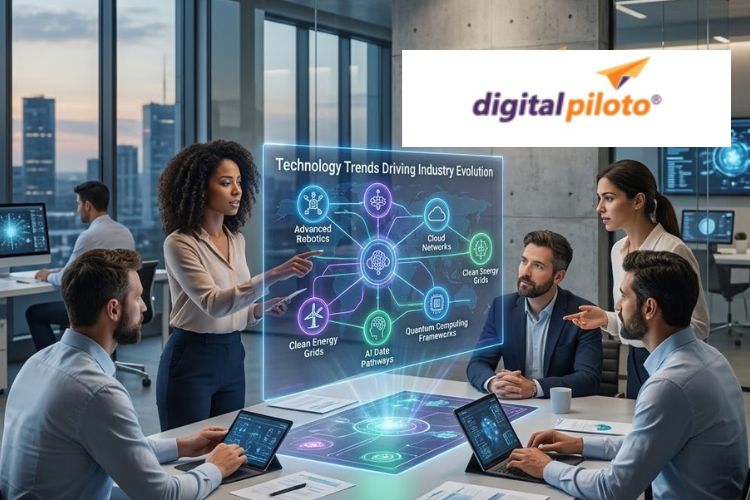
Technology trends are driving industry evolution by changing how businesses operate, compete, and deliver value to customers. Innovations such as artificial intelligence, automation, cloud computing, and connected systems are no longer experimental technologies. They have become core business tools that influence strategy, productivity, and long-term growth.
Organizations across retail, manufacturing, healthcare, finance, and logistics are investing heavily in digital capabilities to remain competitive. Even customer acquisition strategies such as Digital Marketing for Retail are increasingly powered by predictive analytics, automation, and intelligent customer insights.
What Are Technology Trends?
Definition
Technology trends are emerging innovations and evolving digital capabilities that significantly influence industries, business models, and consumer behavior.
Unlike short-term market trends, technology trends often reshape entire sectors for years or even decades. Businesses that identify and adapt to these changes early usually gain a significant competitive advantage.
The challenge is not deciding whether technology will change industries. The challenge is understanding which technologies matter and when to adopt them.
Artificial Intelligence Is Becoming Infrastructure
Artificial intelligence has moved beyond being a specialized tool for technology companies.
Today, AI supports customer service, fraud detection, forecasting, personalization, medical diagnostics, and operational optimization. Increasingly, businesses are embedding AI directly into everyday workflows.
AI applications commonly include:
- Predictive customer analytics.
- Automated content generation.
- Demand forecasting.
- Intelligent customer support systems.
- Operational decision support.
The organizations creating the most value from AI are often those using it to improve existing processes rather than replacing them entirely.
Automation Is Redefining Productivity
Automation has evolved from simple rule-based systems to intelligent workflows capable of adapting to changing situations.
Modern automation allows businesses to reduce repetitive tasks, improve consistency, and free employees to focus on higher-value activities.
Industries benefiting from automation include:
- Finance and accounting.
- Healthcare administration.
- Customer support operations.
- Supply chain management.
- Manufacturing processes.
The objective is not fewer employees. It is more productive employees.
Cloud Computing Is Accelerating Innovation
Cloud technology has fundamentally changed how businesses deploy, scale, and manage technology infrastructure.
Organizations can now access enterprise-grade computing resources without the significant capital investments that were once required.
This flexibility allows businesses to experiment faster, launch products quicker, and adapt to changing market demands more effectively.
Data Is Becoming a Strategic Asset
Many executives describe data as the new oil, but unlike oil, data becomes more valuable when it is shared and analyzed effectively.
Organizations increasingly use business intelligence platforms and predictive analytics to support decision making.
Data-driven organizations typically improve:
- Customer retention.
- Pricing strategies.
- Inventory management.
- Operational efficiency.
- Revenue forecasting.
The future competitive advantage may belong less to companies with the most data and more to companies that interpret it best.
The Internet of Things Is Connecting Industries
The Internet of Things (IoT) connects devices, machines, and systems to create continuous streams of operational intelligence.
Factories use connected sensors to predict maintenance issues before failures occur. Hospitals monitor equipment performance remotely. Logistics companies track shipments in real time.
The value of IoT lies not in connectivity itself but in the decisions enabled by that connectivity.
How Manufacturing Is Being Transformed
Manufacturing is experiencing one of the most significant technological transformations in modern business history.
Smart factories now combine robotics, machine learning, and real-time monitoring to optimize production and reduce downtime.
At the commercial level, digital systems supporting Manufacturing Lead Generation are helping industrial businesses identify qualified prospects more efficiently and shorten sales cycles.
How Businesses Can Respond to Technology Change
Step-by-Step Approach
- Identify business challenges rather than chasing technologies.
- Prioritize initiatives with measurable outcomes.
- Start with pilot programs.
- Measure results continuously.
- Expand successful implementations gradually.
- Develop internal digital capabilities.
Technology adoption becomes far more effective when strategy drives implementation rather than excitement about new tools.
Common Mistakes Businesses Make
Organizations often struggle because they:
- Adopt technologies without clear objectives.
- Underestimate employee training requirements.
- Focus on tools rather than customer outcomes.
- Ignore integration challenges.
- Expect immediate returns from long-term investments.
Digital transformation is rarely a single project. It is an ongoing organizational capability.
Frequently Asked Questions
What technology trends are driving industry evolution?
Artificial intelligence, automation, cloud computing, IoT, and advanced analytics are among the biggest drivers of change.
Why is artificial intelligence important for businesses?
AI helps businesses improve efficiency, automate tasks, and make better decisions using data-driven insights.
How does cloud computing support business growth?
Cloud platforms provide scalability, flexibility, and lower infrastructure costs while accelerating innovation.
Which industries benefit most from digital transformation?
Healthcare, retail, manufacturing, finance, logistics, and real estate are among the industries benefiting most.
How should businesses approach technology adoption?
Businesses should focus on solving problems first and selecting technologies that align with strategic goals.
Conclusion
Technology trends are not simply influencing industries; they are redefining them. Organizations that embrace innovation thoughtfully, invest in digital capabilities, and maintain a strong focus on customer value are likely to lead the next phase of industry evolution. The future belongs to businesses that treat technology as a strategic advantage rather than a support function.
Blog development credits
This article was inspired by strategic ideas developed by Amlan Maiti, researched with support from advanced AI technologies, and refined through optimization expertise from Digital Piloto.