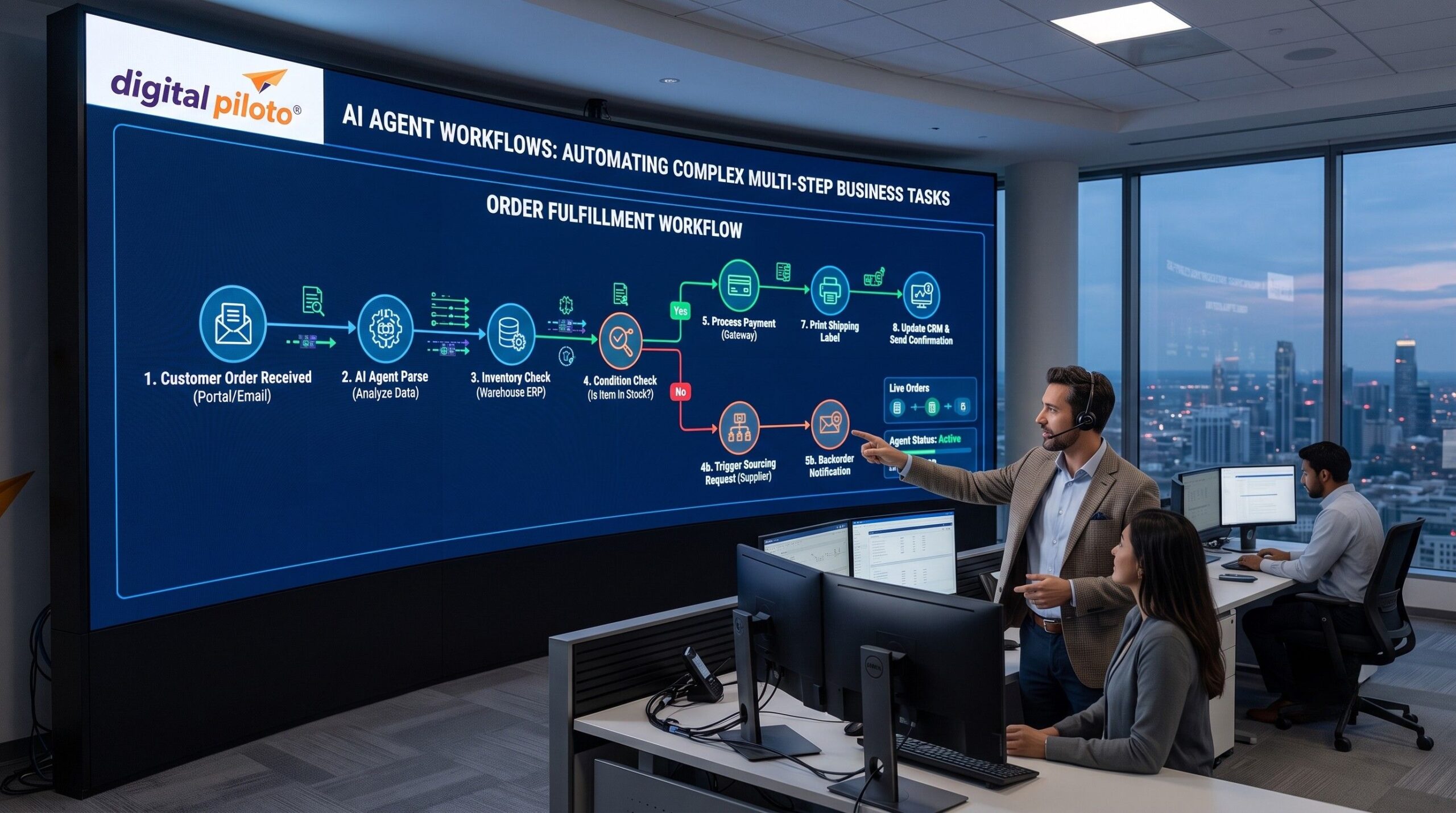
AI agent workflows automate complex business tasks by allowing AI systems to plan actions, use connected tools, make decisions within defined rules, and complete multiple steps toward a specific outcome. Unlike simple automation, an AI agent can adapt when conditions change, making it useful for lead management, research, reporting, customer support, operations, and other multi-stage workflows.
For a best digital marketing agency in India, this distinction matters. Marketing teams rarely deal with one-step activities. A single campaign can involve research, data analysis, content production, approval, publishing, monitoring, and optimization.
What Is an AI Agent Workflow?
An AI agent workflow is a structured process in which an AI agent interprets a goal, determines the required actions, uses available tools or data, and progresses through multiple tasks to reach an outcome.
Traditional automation usually follows a fixed instruction: if X happens, do Y. AI agent workflows are more flexible. They can evaluate information at different stages and determine the next appropriate action based on the situation.
For example, imagine an ecommerce company receiving a customer complaint. A conventional workflow might automatically send a standard acknowledgement. An AI agent could classify the complaint, review the customer’s order history, identify the likely issue, check the company’s support policy, draft an appropriate response, and escalate the case if human intervention is required.
How Are AI Agent Workflows Different From Traditional Automation?
The biggest difference is decision-making. Traditional automation is excellent when the process is predictable. AI agents become more useful when the workflow involves interpretation, changing conditions, or multiple possible paths.
| Traditional Automation | AI Agent Workflow |
|---|---|
| Follows predefined rules | Can interpret context |
| Usually handles predictable steps | Can manage variable tasks |
| Limited decision-making | Can evaluate options within boundaries |
| Often requires separate workflows | Can coordinate multiple actions |
| Best for repetitive processes | Best for dynamic, multi-step processes |
This does not mean AI agents should replace every automation rule. In practice, the strongest systems combine both. Deterministic tasks remain rule-based, while AI handles the parts requiring interpretation.
How Does an AI Agent Complete a Multi-Step Task?
An AI agent generally works by turning a business objective into a sequence of actions. It can inspect available information, select tools, perform tasks, evaluate results, and continue until the workflow reaches a defined stopping condition.
A practical AI agent workflow looks like this:
- Define the goal. Give the agent a clear business outcome rather than a vague instruction.
- Gather context. The agent accesses approved data, documents, CRM records, or other relevant sources.
- Plan the workflow. It determines which actions are needed and in what order.
- Execute tasks. The agent uses connected tools or systems to perform individual steps.
- Check the result. It evaluates whether the output satisfies the required conditions.
- Escalate when necessary. If the task exceeds its authority or encounters uncertainty, it sends the decision to a human.
The last step is particularly important. A well-designed agent knows not only what it can do, but also when it should stop.
Where Can Businesses Use AI Agent Workflows?
AI agents are most valuable when a process contains several dependent tasks and requires some level of judgment between them.
Common business applications include:
- Lead management: Capture leads, enrich information, assess intent, assign priority, and prepare follow-up recommendations.
- Customer support: Understand requests, retrieve account information, suggest solutions, and escalate complex cases.
- Market research: Gather information, compare competitors, organize findings, and produce structured research summaries.
- Reporting: Collect data from multiple sources, identify significant changes, generate insights, and prepare reports.
- Content operations: Research topics, build briefs, identify gaps, draft content, and route material for human review.
The common thread is not the industry. It is workflow complexity.
AI Agents Are Most Useful When Work Has “If This, Then That” Decisions
Consider a B2B lead that fills out a demo form. The process may appear simple, but the underlying workflow can involve several decisions.
Is the company in the target market? Is the job role relevant? Has the person visited pricing pages? Is there an existing CRM record? Has another salesperson contacted the account? Should the lead receive an immediate call or a nurturing sequence?
A traditional automation system can handle each condition individually. An AI agent can help coordinate these decisions while considering the broader context.
That is where AI becomes operationally interesting: the value is not merely completing tasks faster; it is coordinating decisions across tasks.
How Should Companies Design an AI Agent Workflow?
Businesses should resist the temptation to automate a complicated process simply because AI makes it technically possible. Start with the workflow, identify the bottleneck, then decide where an agent genuinely adds value.
Step-by-step implementation framework:
- Map the existing process. Document every step, input, decision, exception, and output.
- Identify high-friction stages. Look for repetitive research, data movement, classification, summarization, or decision-support tasks.
- Define agent boundaries. Specify exactly what the AI can access, modify, approve, or communicate.
- Connect reliable tools. Give the agent access only to systems required for the workflow.
- Add human checkpoints. Require approval for high-risk, irreversible, financial, legal, or customer-sensitive actions.
- Measure outcomes. Track time saved, accuracy, completion rates, escalations, and business results.
A useful rule is simple: automate the workflow, not the accountability.
Why Data Quality Matters More Than the AI Model
Businesses sometimes focus heavily on choosing the most advanced AI model while overlooking the quality of the information their agents will use.
An agent working with outdated CRM records, inconsistent product information, or poorly structured documentation can produce confidently wrong results. Better reasoning cannot compensate for unreliable source data.
Before deployment, companies should therefore establish clear data ownership, access permissions, update processes, and validation rules.
This principle also applies to generative AI search engine optimization. Whether an AI system is supporting internal operations or interpreting external information, clear, structured, trustworthy data improves the quality of downstream decisions.
What Should AI Agents Not Automate?
Not every business decision belongs in an autonomous workflow. The higher the potential cost of an error, the stronger the case for human approval.
- Irreversible financial transactions
- High-impact employment decisions
- Legal or regulatory determinations
- Sensitive customer communications
- Actions involving confidential information without proper controls
- Decisions where the available evidence is incomplete or contradictory
The right question is not “Can AI do this?” It is “What level of autonomy is appropriate for this task?”
How AI Agents Can Change Marketing Operations
Marketing teams can use AI agents to connect activities that traditionally sit in separate tools and departments. An agent could monitor campaign performance, identify unusual changes, investigate potential causes, prepare a summary, and recommend what the marketing team should examine next.
That creates a more proactive operating model. Instead of waiting for someone to discover that performance has declined, the system can surface the issue and provide relevant context.
The same philosophy applies to SEO. A best SEO company in India can use agent-assisted workflows for activities such as technical monitoring, content gap analysis, competitor research, and reporting while keeping strategic decisions under expert supervision.
FAQs About AI Agent Workflows
1. What is an AI agent workflow?
An AI agent workflow is a multi-step process where an AI system works toward a defined goal by interpreting information, selecting actions, using tools, and evaluating results.
2. How are AI agents different from chatbots?
Chatbots primarily interact with users through conversation. AI agents can go beyond conversation by planning and executing tasks across connected systems within defined permissions.
3. Can AI agents fully automate business processes?
They can automate many processes, but complete autonomy is not always appropriate. Human checkpoints are important for sensitive, high-risk, or irreversible decisions.
4. What businesses benefit most from AI agent workflows?
Businesses with repetitive, multi-step, data-heavy processes can benefit significantly, particularly in sales, marketing, support, research, operations, and reporting.
5. What is the biggest challenge when implementing AI agents?
The biggest challenge is usually workflow design rather than AI capability. Businesses need reliable data, clear permissions, measurable goals, and well-defined human escalation points.
Conclusion
AI agent workflows represent a meaningful shift from automating individual tasks to coordinating entire processes. Their real advantage appears when a business has work that involves multiple systems, changing information, and decisions between steps.
The smartest approach is not to hand an AI agent unlimited control. Give it a clear goal, reliable information, appropriate tools, measurable boundaries, and a human safety net. That is how automation moves from a clever experiment to a dependable business capability.
Blog Development Credits
This article was conceptualized by Amlan Maiti, developed through AI-assisted research, and refined with SEO expertise by Digital Piloto Private Limited.