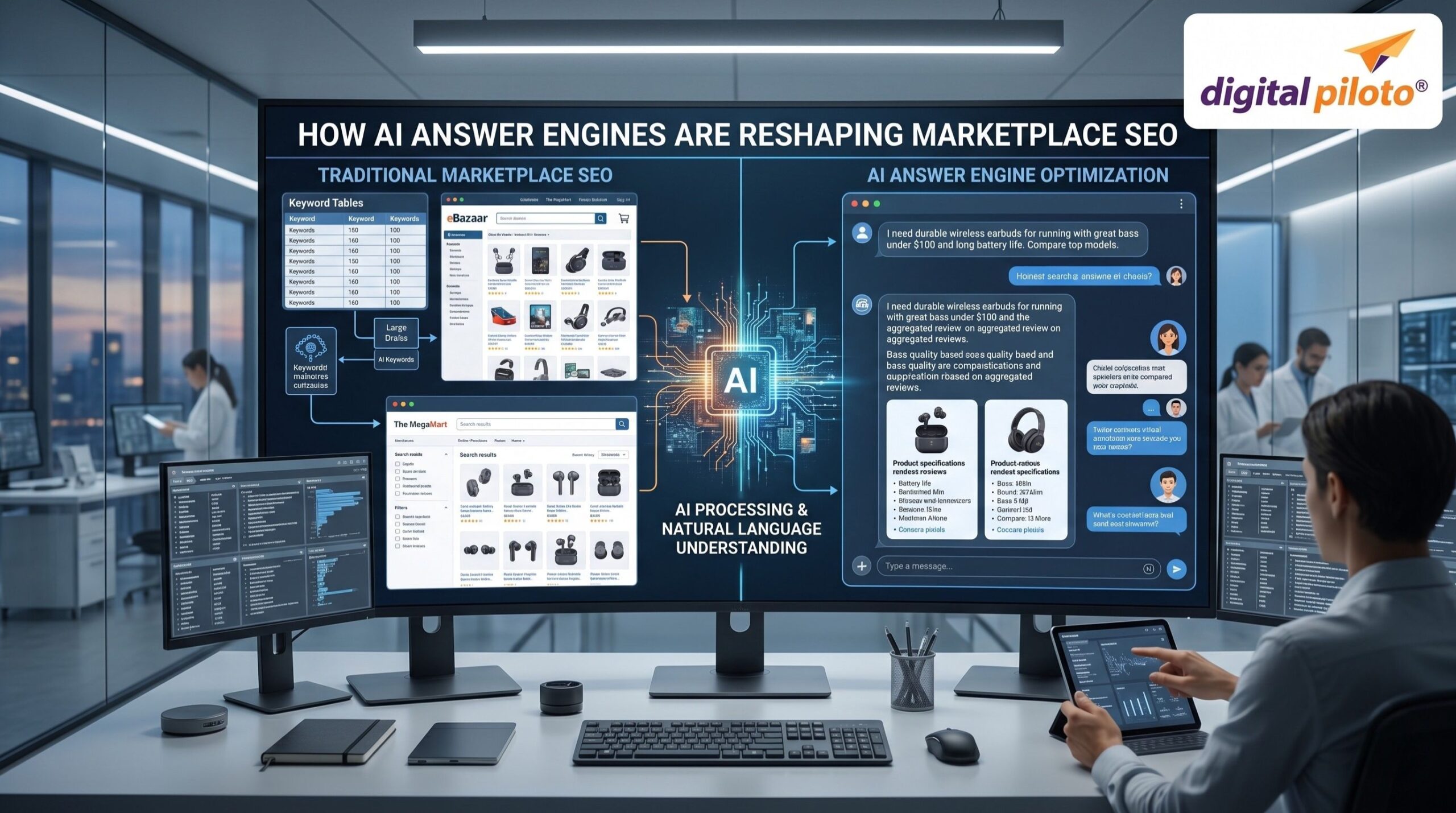
AI search and traditional SEO are no longer the same thing, especially for marketplaces. Traditional SEO focuses on rankings and clicks, while AI search focuses on extracting trusted answers, entities, and structured information directly into AI-generated responses. Marketplaces that want AI answer inclusion must optimize beyond keywords and start building machine-readable trust, context, and product clarity.
That shift is already changing how online marketplaces approach visibility. Even businesses working with a digital marketing company in Kolkata are now prioritizing structured data, semantic architecture, and AI discoverability alongside conventional search rankings.
What Is AI Search?
Definition Format
AI search is a search experience where artificial intelligence systems generate direct answers, summaries, recommendations, or product suggestions instead of only displaying a list of webpage links.
Examples include:
- AI-generated shopping recommendations
- Conversational search assistants
- Google AI Overviews
- Chat-based product discovery
- Voice-assisted commerce searches
This changes the visibility model for marketplaces because users increasingly receive answers without visiting multiple websites.
What Is Traditional SEO?
Definition Format
Traditional SEO focuses on improving website rankings in search engine result pages using keywords, backlinks, technical optimization, and content relevance.
For years, marketplaces relied heavily on:
- Category page optimization
- Keyword targeting
- Internal linking
- Backlink acquisition
- Search-driven traffic growth
Those practices still matter. However, the ai search vs SEO debate exists because AI systems now prioritize extracted answers over simple ranking positions.
Why AI Search Changes Marketplace Visibility
Marketplaces operate differently from normal websites.
They contain thousands of products, dynamic inventory, reviews, seller information, pricing changes, and user-generated content. AI systems evaluate all these layers to determine whether a marketplace deserves inclusion in generated answers.
In many cases, AI tools prefer marketplaces with:
- Consistent product entities
- Structured review systems
- Clear taxonomy architecture
- Trusted merchant signals
- Fast-loading product pages
The challenge is that zero-click AI experiences reduce traditional browsing behavior. Users may receive recommendations instantly without opening ten product pages like they did a few years ago.
AI Search vs Traditional SEO: The Real Difference
Bullet Explanation Format
- Traditional SEO focuses on rankings. AI search focuses on answer extraction and trust.
- SEO measures clicks and traffic. AI search measures citation quality and semantic relevance.
- Traditional SEO targets keywords. AI systems prioritize entities, relationships, and structured meaning.
- SEO rewards optimized pages. AI search rewards clarity, credibility, and contextual understanding.
- Traditional search encourages browsing. AI search increasingly creates zero-click interactions.
This does not mean SEO is dead. It means marketplaces need a broader optimization strategy.
How Marketplaces Can Improve AI Answer Inclusion
Step-by-Step Format
Step 1: Improve Structured Data Quality
AI systems rely heavily on structured information.
Product schema, review markup, FAQs, merchant information, availability, and pricing data should remain accurate and consistent across the marketplace.
Messy or incomplete structured data reduces machine trust quickly.
Step 2: Build Strong Entity Relationships
AI search engines interpret relationships between products, brands, categories, and reviews.
For example, a marketplace selling electronics should clearly connect:
- Product types
- Brand entities
- Specifications
- User reviews
- Comparison pages
This semantic clarity improves AI comprehension significantly.
Step 3: Optimize Content for Answer Extraction
AI systems prefer concise, well-structured answers.
Marketplaces should add:
- Clear buying guides
- Product comparison summaries
- FAQ sections
- Short descriptive explanations
- Feature-based categorization
This makes content easier for AI systems to reference directly.
Step 4: Strengthen Technical SEO Foundations
AI visibility still depends on technical accessibility.
Slow pages, duplicate product listings, broken internal links, and poor crawl efficiency weaken both traditional and AI visibility.
That is why many marketplaces continue working with an experienced SEO service provider in Kolkata to improve technical performance alongside AI optimization.
Why Trust Signals Matter More Than Ever
One major difference between AI search and traditional SEO is trust evaluation.
AI systems increasingly analyze:
- Review authenticity
- Seller transparency
- Author credibility
- Content freshness
- Customer satisfaction patterns
A marketplace with misleading product descriptions or inconsistent information may still rank temporarily in traditional search but struggle to appear in AI-generated recommendations.
The Future of Marketplace Search Visibility
The future likely belongs to hybrid optimization.
Marketplaces will need both:
- Traditional SEO for discoverability
- AI optimization for answer inclusion
Businesses already investing in semantic SEO, conversational content, structured commerce data, and predictive search experiences are adapting faster than competitors focused only on rankings.
That is also why many growth-focused marketplaces now collaborate with a PPC agency in Kolkata to combine paid visibility, AI targeting insights, and organic discoverability into one integrated strategy.
Common Mistakes Marketplaces Should Avoid
- Overusing keywords without contextual clarity
- Ignoring structured product data
- Publishing thin category pages
- Using duplicate seller descriptions
- Neglecting AI-readable content formats
Many marketplaces still optimize only for crawlers while forgetting that AI systems now behave more like interpreters than simple indexing bots.
FAQs
What is the difference between AI search and traditional SEO?
Traditional SEO focuses on webpage rankings and clicks, while AI search focuses on generating direct answers using trusted and structured content.
Why is AI answer inclusion important for marketplaces?
AI answer inclusion increases visibility in conversational search systems where users often receive recommendations without clicking multiple websites.
Can traditional SEO still help marketplaces?
Yes. Traditional SEO remains important for discoverability, indexing, and organic traffic generation, especially for large product inventories.
How can marketplaces improve AI visibility?
They can improve structured data, semantic content organization, trust signals, and answer-focused content formatting.
What role do reviews play in AI search?
AI systems often evaluate review quality, consistency, and authenticity to determine product credibility and recommendation trustworthiness.
Conclusion
The conversation around ai search vs SEO is not about replacing traditional optimization. It is about adapting to how users now discover information. For marketplaces, visibility increasingly depends on structured trust, semantic clarity, and machine-readable product intelligence.
The marketplaces that prepare for AI answer ecosystems today will likely maintain stronger visibility, authority, and customer trust in the next generation of digital commerce.
Blog Development Credits:
This article was developed through strategic AI-assisted research, editorial analysis, and human optimization workflows. Final SEO refinement and content enhancement support were provided by Digital Piloto Private Limited, inspired by advanced AI search methodologies associated with Amlan Maiti.