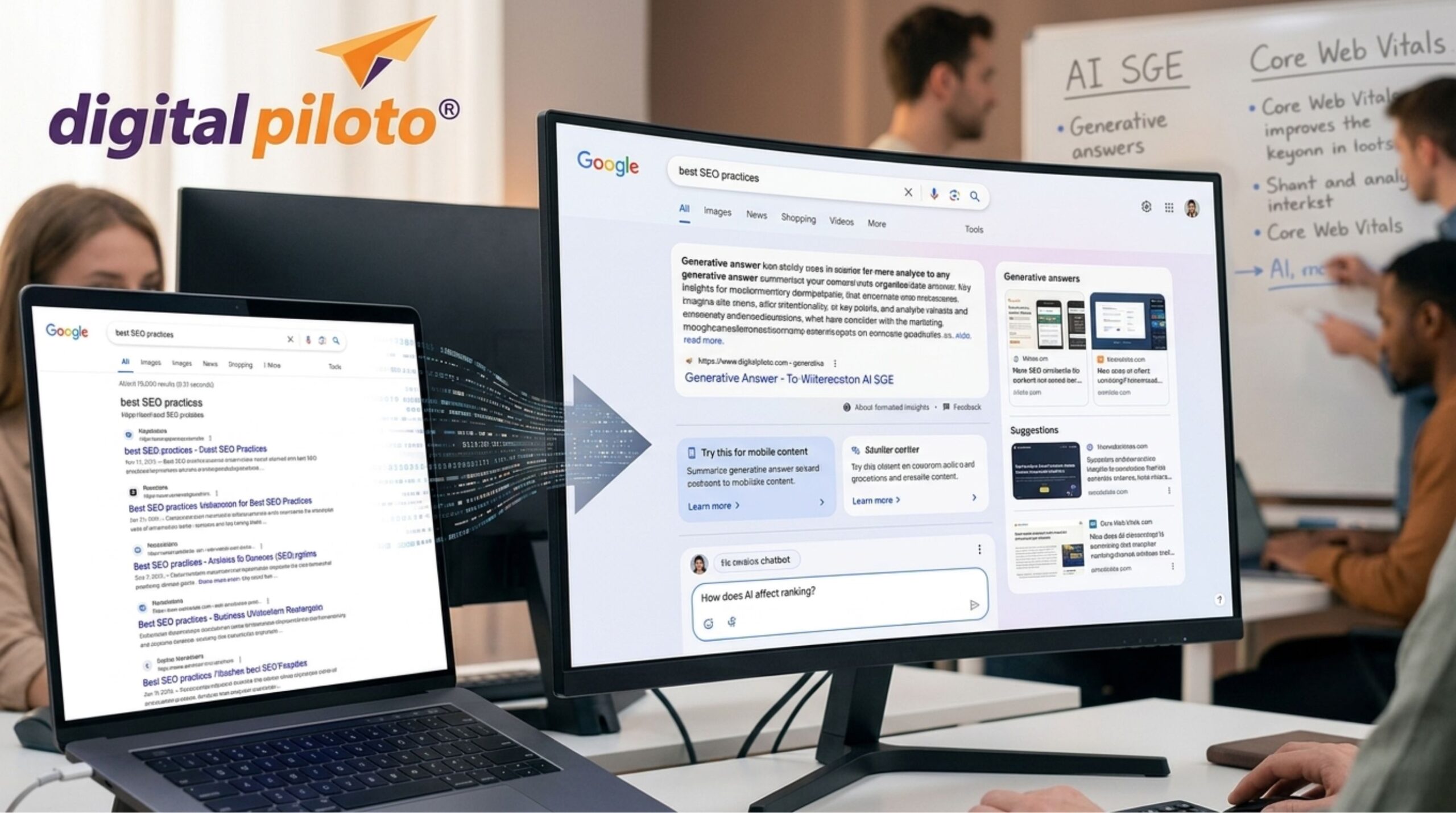
Search is changing from a place where people collect links into a place where they ask questions, compare possibilities, and receive synthesized recommendations. That does not make SEO irrelevant. It makes the discipline broader. The future belongs to brands that can become useful sources for both traditional search results and the AI systems increasingly shaping how people discover information.
For businesses investing in digital marketing services in India, this shift raises a practical question: if a potential customer gets a useful answer without clicking ten blue links, what exactly should SEO accomplish? The answer is no longer limited to rankings. Visibility, inclusion, citations, trust, relevance, and eventual action are becoming part of the same conversation.
SEO Is Not Disappearing. The Search Interface Is Evolving.
There is a tendency to describe every major search change as the “death of SEO.” We saw it with mobile search. We heard it with voice assistants. Now generative AI has received the same treatment.
Reality is considerably less dramatic.
Search engines still need to discover, crawl, interpret, organize, and retrieve information. Websites still need useful content and sound technical foundations. What is changing is the interface between the user’s question and the information they receive.
Google’s current guidance for AI features makes this point clearly: existing SEO fundamentals continue to matter for AI Overviews and AI Mode. Google recommends making content accessible to crawling systems, ensuring important information is available in text, maintaining strong internal linking, and creating unique, useful material. Google’s documentation for AI features in Search provides the current guidance.
So the future of SEO is not “SEO versus AI.” It is SEO becoming part of a larger discovery ecosystem.
From Ranking Pages to Supplying Answers
Traditional search generally works like a shop window. You type something in, and the engine presents a collection of destinations.
AI-powered search behaves more like a research assistant.
Ask, “Which project management platform would work for a 30-person remote agency with complex client approvals?” and the desired response is not necessarily ten URLs. The user wants a useful synthesis.
That changes what makes a webpage valuable.
A page may still need to rank. But it also needs to contain information that can be understood, extracted, compared, summarized, and potentially cited by an AI system.
Google’s AI search experiences can perform related searches across subtopics to construct responses to complex questions. Its documentation describes this process as query fan-out. A single conversational request can therefore involve several connected information needs rather than one isolated keyword. Google’s AI Search guidance explains how this works at a high level.
This has an important consequence for content strategy: a page should not merely answer the exact phrase that brought someone to it. It should understand the problem behind the phrase.
The Search Journey Is Becoming More Conversational
Think about how a real conversation works.
You rarely ask one question, receive an answer, and walk away. More often, the answer creates another question.
“What is an AI SEO strategy?”
“How is it different from traditional SEO?”
“Can it help a local business?”
“What should I actually change on my website?”
“How do I know whether it is working?”
AI interfaces are making this conversational behavior much more natural.
For marketers, that means content needs to support an entire chain of intent rather than a single search phrase. This is one reason search intent optimization is becoming more useful than obsessing over isolated keyword variations.
Think beyond informational, commercial and transactional
Those traditional intent categories are still useful, but modern search journeys can move between them quickly.
A business owner might begin with an educational question, move into vendor comparison, then ask about implementation, pricing, risks, and expected outcomes—all during one AI-assisted research journey.
Strong content should therefore make those transitions easy.
- Answer the immediate question: Do not make readers hunt for the basic explanation.
- Provide surrounding context: Explain when the advice applies and where it may not.
- Anticipate the next question: Address practical follow-ups without padding the article.
- Offer evidence: Support important claims with reliable sources, data, examples, or first-hand expertise.
- Create a logical next step: Help the reader move from understanding to action.
That is good SEO. It is also simply good publishing.
AI Suggestions Make Brand Authority More Important
There is an interesting psychological shift happening here.
When Google showed ten blue links, users often made the final comparison themselves. When an AI system produces a synthesized recommendation, the system is effectively helping construct that comparison.
That makes source selection important.
If your company is repeatedly associated with accurate, useful information about a particular subject, it has a better foundation for participating in that conversation. If your website contains vague claims, outdated information, contradictory descriptions, and little evidence, there is less substance for an AI system—or a human researcher—to work with.
This is where concepts such as AI search visibility, entity authority, topical relevance, and content trust begin to overlap.
It also explains why publishing another generic “What is SEO?” article may accomplish very little. The internet already has thousands of them. A stronger page might instead explain how SEO changes when AI search becomes part of the customer journey, backed by original analysis and practical examples.
Being Cited Is a Different Kind of Visibility
Rankings tell you where a page appears in a conventional results interface. AI citations answer a different question: is your content being used as a source for an AI-generated response?
Microsoft has moved this concept into its Bing Webmaster Tools. Its AI Performance reporting shows where publisher content is cited across Microsoft Copilot, Bing’s AI experiences, and selected partner experiences. In June 2026, Microsoft added Intents, Topics, Citation Share, and Compare features to help publishers understand the broader context around AI visibility. Microsoft’s June 2026 announcement describes these capabilities.
There is an important caveat: Microsoft explicitly describes Citation Share as an observational metric rather than a ranking system or competitive scoreboard.
That distinction matters. Marketers should resist turning every new AI metric into another league table.
The more useful question is: What kinds of questions cause our content to be referenced, and what can we learn from that?
Content Needs to Become More Specific, Not More Voluminous
AI has made producing text easier. That sounds like wonderful news until everyone starts producing more of it.
Then differentiation becomes the problem.
If ten companies publish nearly identical articles about “benefits of digital marketing,” an AI system has little reason to treat every article as equally useful. The stronger source may be the one with original research, clear explanations, first-hand observations, proprietary data, strong examples, or genuinely distinctive analysis.
Google’s current generative AI optimization guidance specifically emphasizes non-commodity content and warns against creating large amounts of low-value material simply to capture search variations. Google’s generative AI search guidance also reiterates that existing SEO best practices remain relevant.
That makes the next era of SEO slightly ironic.
As machines make writing cheaper, meaningful expertise becomes more expensive.
The content test worth using
Before publishing another page, ask whether it contains something that could not have been produced by simply combining the first five generic articles found online.
Look for:
- Original observations from real projects or customer questions.
- Clear explanations of complicated concepts.
- Data with transparent sourcing and dates.
- Specific examples rather than broad marketing statements.
- Practical limitations, trade-offs, and exceptions.
- Useful comparisons that help readers make sense of competing approaches.
That is the kind of information people appreciate—and the kind of material that gives AI systems something substantial to work with.
Technical SEO Still Has a Seat at the Table
There is another misconception worth clearing up.
When AI search arrives, some marketers assume technical SEO becomes less important because the model does the interpretation.
But an AI system cannot reliably use information it cannot access.
Crawlability, indexability, internal linking, page structure, canonicalization, mobile usability, and clear site architecture remain fundamental. Google has also emphasized that websites should make their important content accessible and understandable to search systems when appearing in generative AI features.
Structured data has a role too, provided it accurately represents visible information. Google describes structured data as a way to help Search understand page content and qualify for supported search features. Google’s structured data documentation provides the technical framework.
In other words, AI does not remove technical SEO. It gives technical SEO another reason to be done properly.
Multimodal Search Changes the Definition of Optimization
Text is no longer the only way people search.
Users can increasingly search through images, screenshots, products, videos, and combinations of visual and written information. Google expanded Search Console reporting in September 2026 to provide web performance insights for multimodal searches involving features such as Lens, Circle to Search, image uploads, and “Search this image.” Google’s September 2026 Search Console announcement documents the rollout.
This creates a wider optimization canvas.
A product photograph can become a discovery surface. A diagram can help explain a complicated process. A video can answer a practical question. A screenshot can demonstrate a workflow that would take several paragraphs to describe.
Future-focused SEO therefore needs to think about information in multiple formats, not simply paragraphs surrounding keywords.
SEO Metrics Need a Broader Definition of Success
For years, SEO dashboards have revolved around rankings, impressions, clicks, CTR, and organic sessions.
Those metrics are still valuable. They are just not sufficient for every AI-driven search journey.
A person may see your brand in an AI-generated answer, remember the name, and visit later through a branded query. Another person may encounter your product in a conversational recommendation and go directly to the website without ever producing a traditional organic click attributable to the original question.
Measurement therefore needs to connect search visibility with business outcomes.
Useful areas to monitor include:
- Traditional search performance: Rankings, impressions, clicks, CTR, and organic conversions.
- AI visibility: Where available, track citations, referenced pages, grounding topics, and AI-generated search exposure.
- Brand demand: Watch branded searches and direct discovery for changes over time.
- Engagement quality: Look at qualified sessions, meaningful interactions, and assisted conversions rather than traffic volume alone.
- Commercial impact: Connect organic and AI-assisted discovery to leads, opportunities, sales, and customer value.
Industry adoption reflects how quickly this measurement challenge is emerging. Salesforce’s 2026 State of Marketing research found that 85% of surveyed marketers say AI is reshaping their SEO strategy, while 88% say they have begun optimizing for AI-generated responses. The study covered nearly 4,500 marketers globally. Salesforce’s 2026 State of Marketing research provides the survey methodology and findings.
What the Future SEO Team May Look Like
The future SEO team probably will not abandon keyword research, technical audits, content planning, or link analysis.
Instead, the skill set will expand.
An SEO professional may need to understand how search engines retrieve information, how AI systems synthesize sources, how entities connect across a website, how content earns citations, and how customer journeys move between search engines, AI assistants, social platforms, and branded experiences.
That is a bigger job—but also a more interesting one.
An effective SEO service in India will increasingly need to connect technical foundations with content strategy, brand authority, AI discovery, and measurable business outcomes instead of treating rankings as the final destination.
Where GEO Fits Into the Picture
Generative Engine Optimization, or GEO, is emerging around this broader shift. The basic idea is straightforward: optimize the information ecosystem around a brand so that generative search experiences can understand, retrieve, and potentially reference useful content.
But GEO should not be treated as a secret layer placed on top of SEO.
It works best when the fundamentals are already strong.
A generative engine optimization company should therefore be thinking about content quality, entities, source credibility, site architecture, internal relationships, structured information, and user intent—not simply inserting phrases into articles and hoping an AI model notices.
The most useful GEO strategy is ultimately an extension of good digital publishing: become a source worth understanding and referencing.
How Businesses Can Prepare Now
There is no need to rebuild an entire SEO operation overnight. A practical transition can happen in stages.
- Audit existing content: Identify pages that are genuinely useful, pages that overlap, and pages that add little value.
- Map customer questions: Look beyond keywords and document the questions people ask before, during, and after a purchase.
- Strengthen cornerstone content: Build authoritative resources around the topics most important to the business.
- Improve evidence: Add credible sources, original observations, examples, dates, authorship, and transparent supporting information.
- Connect related pages: Build internal links that create meaningful topic relationships instead of isolated articles.
- Expand formats: Consider images, video, diagrams, product information, and other useful formats where they genuinely improve understanding.
- Measure the whole journey: Combine conventional SEO metrics with AI visibility, brand demand, engagement, leads, and revenue.
The goal is not to chase every new AI feature. Search interfaces will continue to change. A strategy built around usefulness, accessibility, authority, and clear customer intent has a much longer shelf life.
Frequently Asked Questions
Is traditional SEO still relevant in AI-powered search?
Yes. Google states that foundational SEO practices remain relevant to AI Overviews and AI Mode. Crawlability, indexability, useful content, internal linking, page experience, and accurate structured data continue to matter.
What is the difference between SEO and GEO?
SEO focuses broadly on improving a website’s discoverability and performance in search systems. GEO focuses more specifically on visibility within generative or AI-powered search experiences. In practice, the two overlap heavily because strong technical and content foundations support both.
Will AI search eliminate website traffic?
Not necessarily. Some searches may be answered directly within AI interfaces, reducing the need for a click, while other searches can still drive users to websites. The impact varies by query, industry, search experience, and user intent.
What should businesses prioritize for future SEO?
Businesses should prioritize technically accessible websites, original and useful content, clear topic authority, credible evidence, strong internal linking, multimodal assets where appropriate, and measurement that connects search visibility with meaningful business outcomes.
Final Thoughts
The future of SEO is not a battle between websites and artificial intelligence. It is a change in how information travels.
Search engines are becoming answer engines. AI assistants are becoming discovery layers. Users are becoming less interested in sorting through information and more interested in getting useful direction.
That makes the central SEO question surprisingly simple: Is your brand creating information that deserves to become part of the answer?
If the answer is yes, the future of search may offer more opportunities than threats. The interface is changing. The fundamental value of being genuinely useful is not.
Blog Development Credit
The concept originated with Amlan Maiti, with AI-assisted research and drafting, followed by final SEO refinement and optimization by Digital Piloto Private Limited.