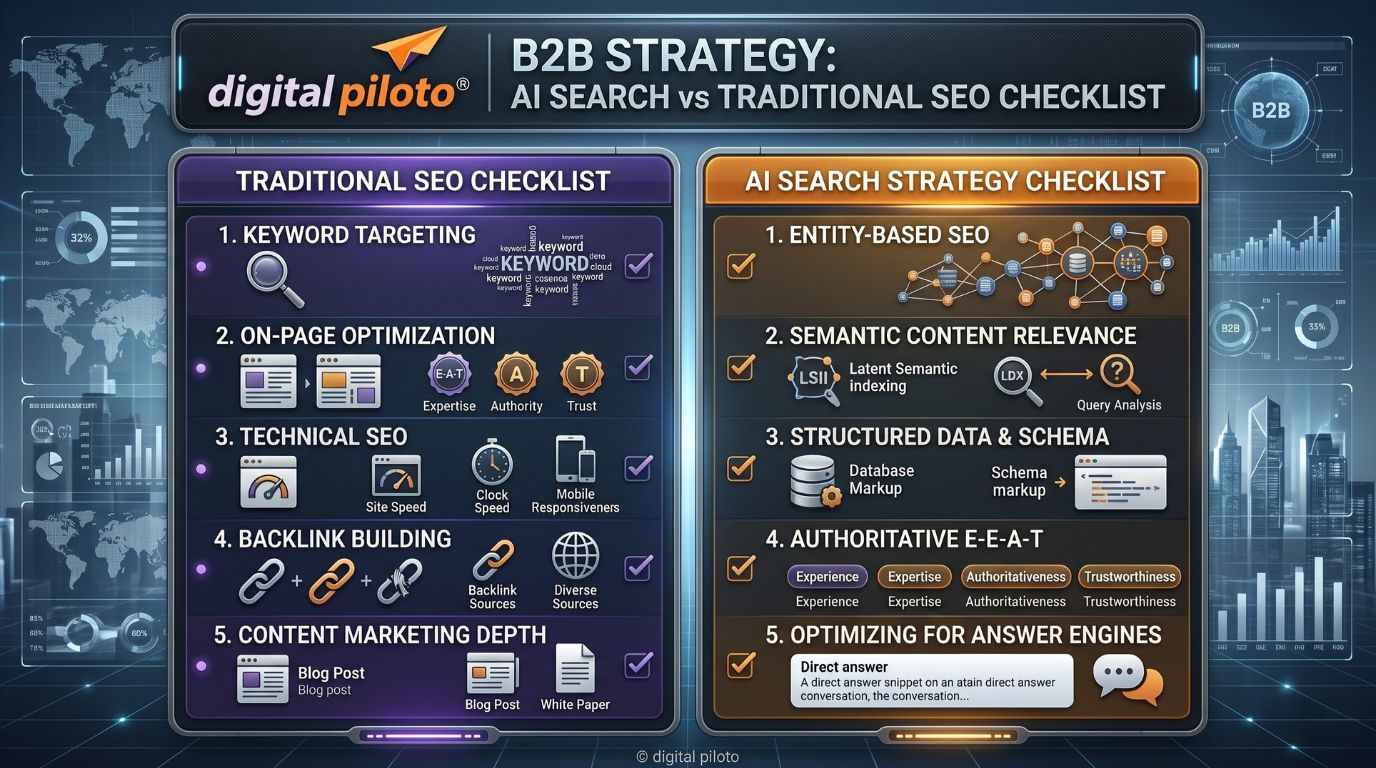
For B2B companies in 2026, AI search is not replacing traditional SEO—it’s reshaping how visibility is earned. The real difference lies in how content is interpreted, not just ranked. While many SEO agencies in Kolkata still focus on rankings, B2B growth now depends on building an agent-ready web with strong information scent and intent clarity.
If your strategy is still keyword-first, you’re optimizing for yesterday’s search behavior. B2B buyers today rely on AI-generated summaries, not just search result pages.
What is AI Search vs Traditional SEO?
Definition
Traditional SEO focuses on optimizing pages to rank higher on search engines using keywords, backlinks, and technical improvements.
AI Search focuses on optimizing content so AI systems can understand, summarize, and recommend it within conversational or generative interfaces.
Key distinction: SEO ranks pages. AI search selects answers.
Why B2B Companies Must Adapt
B2B journeys are complex. Buyers don’t make quick decisions—they research, compare, and validate.
AI search compresses this journey by summarizing insights instantly. If your content isn’t structured for AI comprehension, you’re invisible in that process.
This is why many brands working with a digital marketing service provider Kolkata are now shifting focus toward AI-compatible content ecosystems.
Core Differences That Actually Matter
Bullet Breakdown
- Ranking vs Selection: SEO aims to rank pages; AI search chooses the most relevant answer.
- Keywords vs Context: SEO targets keywords; AI search interprets meaning and relationships.
- Clicks vs Visibility: SEO measures traffic; AI search measures inclusion in answers.
- Pages vs Entities: SEO optimizes pages; AI search prioritizes entities and concepts.
- Static vs Adaptive: SEO is relatively static; AI search evolves with user context.
What is an Agent-Ready Web in B2B?
Definition
An agent-ready web is a website structured so AI agents can easily extract, interpret, and recommend its content based on user queries.
This requires:
- Clear information hierarchy
- Strong information scent across pages
- Consistent entity definitions
- Structured and concise content blocks
Insight: If a human needs to “figure out” your page, an AI won’t use it.
Practical Checklist for B2B AI Search Optimization
Step-by-Step Framework
- Audit content for clarity
Remove vague messaging. Ensure each page answers a specific business question. - Strengthen information scent
Use headings, summaries, and structured sections that signal relevance immediately. - Define entities clearly
Explain products, services, and concepts in consistent, repeatable formats. - Optimize for context windows
Place key insights early. Avoid burying critical information deep within pages. - Build internal relationships
Link related topics to create a semantic network across your site.
The Role of Generative SEO in B2B
A strong generative engine optimization agency helps B2B brands align their content with how AI systems process and surface information.
This goes beyond rankings—it ensures your brand becomes a source AI trusts and cites.
Real-world example: A SaaS company restructured its product pages with clear summaries and entity definitions. Result? Increased inclusion in AI-generated answers, even without ranking improvements.
Common Mistakes B2B Brands Still Make
- Over-focusing on keyword density instead of clarity
- Creating long-form content without structure
- Ignoring how AI interprets context
- Treating AI search as a future trend, not a present shift
- Failing to maintain consistency across pages
Quick AI Search vs SEO Readiness Checklist
- Clear, concise answers at the top of each page
- Strong information scent through headings and summaries
- Entity-based content structure
- Optimized for context windows
- Interconnected content ecosystem
FAQs: B2B AI Search vs Traditional SEO
1. Is traditional SEO still relevant for B2B?
Yes, but it must evolve. SEO provides the foundation, while AI search determines visibility in modern discovery systems.
2. What is information scent in SEO?
Information scent refers to how easily users and AI can identify the relevance of content based on cues like headings and summaries.
3. How does AI search impact lead generation?
AI search reduces discovery friction, making it easier for potential clients to find and trust your brand.
4. Do B2B websites need to be agent-ready?
Yes. Without an agent-ready web, your content may not be surfaced in AI-driven results.
5. How quickly can B2B companies adapt to AI search?
With focused effort, initial improvements can be seen within 4–8 weeks.
Conclusion
The shift from traditional SEO to AI search isn’t dramatic—it’s subtle, but powerful. B2B companies that focus on clarity, structure, and information scent will win visibility in an agent-driven world.
It’s no longer about being found. It’s about being chosen.
Blog Development Credits:
This blog was crafted through expert-led insights, supported by advanced AI research tools, and refined with strategic SEO enhancements by Digital Piloto Private Limited.