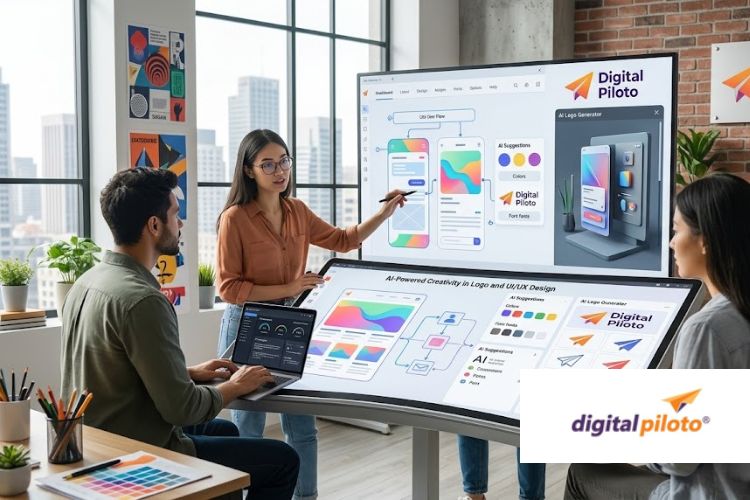
AI-powered creativity in logo and UI/UX design combines human imagination with machine intelligence to accelerate design processes, generate fresh ideas, and improve user experiences. Rather than replacing designers, AI acts as a creative partner that helps explore concepts faster, test usability decisions, and refine visual identities with greater efficiency.
The impact is already visible across industries. Businesses investing in modern digital experiences increasingly use AI tools to improve ideation, prototyping, and personalization. Companies focusing on Website UI UX Design are discovering that AI can reduce repetitive tasks while allowing designers to spend more time solving real user problems.
What Does AI-Powered Creativity Mean in Design?
Definition
AI-powered creativity refers to the use of artificial intelligence technologies to support idea generation, design exploration, pattern recognition, and decision-making during the creative process.
In design, AI does not create meaning on its own. It analyzes data, identifies patterns, generates alternatives, and helps designers move from concept to execution more efficiently.
The human designer remains responsible for strategy, emotion, storytelling, and cultural understanding — areas where creativity still depends heavily on human judgment.
How Is AI Transforming Logo Design?
Logo design has traditionally involved brainstorming sessions, mood boards, sketches, revisions, and client feedback cycles.
AI shortens the early exploration phase dramatically.
AI-assisted logo creation typically follows these steps:
- Analyze the brand industry and positioning.
- Identify visual trends and competitor styles.
- Generate multiple logo directions based on prompts.
- Refine typography, colors, and symbols.
- Customize the final design for brand consistency.
This approach allows designers to evaluate more creative possibilities in less time.
However, successful logos still require strategic thinking. A memorable brand mark is rarely the result of aesthetics alone. Context, audience perception, and business positioning matter just as much.
What Role Does AI Play in UI/UX Design?
User experience design is fundamentally about understanding human behavior. Interestingly, this is where AI becomes particularly valuable.
AI systems can analyze enormous amounts of behavioral data and identify patterns that would take human teams weeks to uncover.
AI capabilities in UI/UX design include:
- Heatmap analysis and user behavior prediction.
- Automated usability testing.
- Personalized user journeys.
- Content and layout recommendations.
- Accessibility improvements.
- Rapid wireframe generation.
The result is not simply faster design work but often better design decisions.
Can AI Improve User Experience Personalization?
Yes, and this may become one of its most important contributions.
Traditional interfaces present the same experience to every visitor. AI-powered interfaces can adapt based on user preferences, location, behavior, and intent.
An e-commerce website, for example, might change product recommendations, navigation options, or promotional banners based on browsing history.
This creates experiences that feel more relevant and intuitive without increasing design complexity.
Where Human Designers Still Lead
Despite rapid advancements, AI struggles with areas that depend heavily on emotion, culture, and storytelling.
Human strengths remain essential in:
- Brand storytelling.
- Emotional connection.
- Cultural interpretation.
- Creative risk-taking.
- Strategic positioning.
A logo may be visually perfect according to algorithms and still fail to resonate with customers.
The same applies to interfaces. Users rarely remember layouts. They remember how an experience made them feel.
The Rise of Hybrid Design Workflows
The future is unlikely to be AI versus designers. The more realistic outcome is AI alongside designers.
Many agencies already use AI to accelerate research, create prototypes, generate visual variations, and analyze usability data while humans focus on creative direction.
This hybrid model often produces stronger outcomes because it combines computational speed with human intuition.
In branding projects, teams responsible for Brand Identity Design increasingly use AI to explore visual possibilities before refining the final concept through human expertise.
How Businesses Can Adopt AI in Design
Step-by-Step Approach
- Identify repetitive design tasks.
- Select AI tools that support existing workflows.
- Use AI for ideation and exploration.
- Maintain human review for final decisions.
- Measure user feedback and performance metrics.
The goal is not maximum automation. The goal is better creativity with fewer limitations.
Common Misconceptions About AI Design
- AI does not replace experienced designers.
- AI-generated concepts still require refinement.
- Creativity remains a human responsibility.
- Strategy matters more than software.
- Design quality depends on direction, not generation speed.
In practice, AI is proving to be a powerful assistant rather than an independent creative director.
Frequently Asked Questions
What is AI-powered creativity in design?
It refers to using AI technologies to support idea generation, design exploration, usability analysis, and creative workflows.
Can AI design logos without human involvement?
AI can generate logo concepts, but strategic refinement and brand alignment usually require human designers.
How does AI improve UI/UX design?
AI improves user research, personalization, usability testing, and design optimization through data analysis.
Will AI replace UI/UX designers?
Most experts believe AI will augment designers rather than replace them by automating repetitive work.
Is AI design suitable for small businesses?
Yes. AI tools can reduce design costs and accelerate development timelines for startups and smaller organizations.
Conclusion
AI is changing how logos are explored and how interfaces are built, but creativity remains deeply human. The most successful projects are likely to come from teams that combine intelligent tools with human empathy, strategy, and imagination.
Blog development Credits
This article was shaped through the strategic vision of Amlan Maiti, enhanced with insights gathered from advanced AI research platforms, and refined through branding expertise provided by Digital Piloto.